
 US Dollars
Abrasive Belts: Types, Grits & Best Applications
Apr 1st 2026
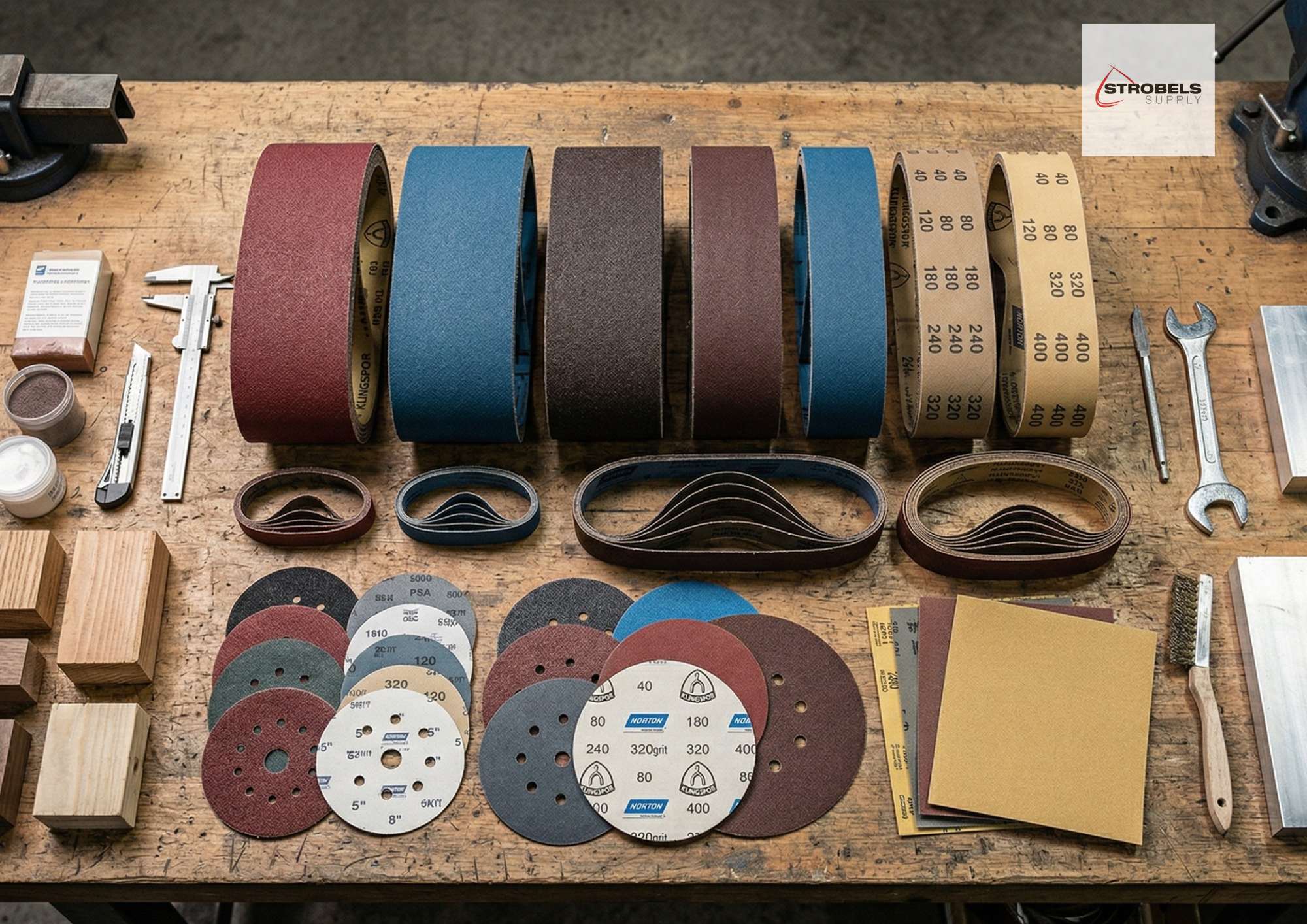
THE COMPLETE GUIDE TO ABRASIVE BELTS
Basics • Applications • Grits • Brands • Buying Guide • Maintenance
Everything you need to know from choosing the right grit to getting the best finish on metal, wood, and more, with expert insights from Strobels Supply.
Table of Contents
Use the sections below to navigate quickly, or read the guide in full for a complete understanding of abrasive belts.
- Abrasive Belts Basics — What They Are and How They Work
- Abrasive Belts by Application — Choosing the Right Belt for the Job
- Sizes, Grits & Specifications — The Numbers Explained
- Brands, Series & OEM Belts — Top Manufacturers Compared
- Buying Guide — Where to Buy and How to Choose a Supplier
- Maintenance, Cleaning & Troubleshooting — Keeping Belts in Top Shape
1. Abrasive Belts Basics: What They Are and How They Work
If you've ever sanded a piece of wood, ground a weld flush, or polished a knife blade, you've benefitted from an abrasive belt — even if you didn't know exactly what was happening at the microscopic level. Understanding how these tools are built and why they work the way they do will help you pick better belts, get better results, and waste less money.
What Is an Abrasive Belt?
An abrasive belt is a continuous loop of flexible material coated with abrasive grains. It runs over two or more rollers on a belt sander or grinder, creating a fast-moving abrasive surface that removes material from a workpiece. The belt cuts, grinds, deburrs, or finishes depending on the grain type, grit size, and the speed and pressure applied.
Unlike grinding wheels, abrasive belts are flexible and conformable, allowing them to follow contours. They also dissipate heat more efficiently — an important advantage when working with heat-sensitive materials like titanium or stainless steel.
|
Why Abrasive Belts Matter Abrasive belts are the workhorse of surface finishing. They're faster than hand sanding, more versatile than grinding wheels, and produce more consistent results than disc sanders for flat or contoured surfaces. From furniture shops to aerospace manufacturing, they're irreplaceable. |
The Five Components of an Abrasive Belt
Every belt is built from these five layers working together:
|
Component |
What It Does |
Common Materials |
|
Backing |
The substrate that carries everything else — must balance flexibility with strength |
Cloth (J/X/Y weight), Paper (A–F), Polyester film, Non-woven fibre |
|
Bond (Maker Coat) |
The adhesive that locks grains into the backing — the foundation coat |
Hide glue, resin, epoxy |
|
Grain |
The cutting edge — removes material from the workpiece |
Aluminium oxide, Zirconia, Ceramic, Silicon carbide, Diamond, CBN |
|
Size Coat |
Second adhesive layer that locks grains in place and determines hardness |
Resin, epoxy; can include grinding aids |
|
Joint/Splice |
Where the belt ends are joined to create the continuous loop |
Overlap (butt), Sheldahl splice, tape splice, butt joint with tape |
Backing Weights Explained
The backing weight determines flexibility and durability. This is one of the most important specs to understand when selecting a belt:
|
Code |
Material |
Weight / Flexibility |
Best For |
|
A |
Paper |
Lightest, most flexible |
Hand sanding, light finishing |
|
C/D |
Paper |
Medium, moderate flex |
Cabinet work, intermediate sanding |
|
E/F |
Paper |
Heavy paper |
Aggressive stock removal |
|
J |
Cotton cloth |
Flexible cloth |
Contour sanding, portable sanders |
|
X |
Cotton/poly cloth |
Semi-flexible, strong |
Bench, stationary, wide-belt |
|
Y |
Poly/cotton |
Stiff, heavy duty |
Heavy grinding, wide belt machines |
|
Film |
Polyester film |
Very consistent, smooth |
Precision finishing, automotive |
Types of Abrasive Belts
Not all abrasive belts are coated the same way. Here's a breakdown of the main types:
1. Coated Abrasive Belts
The most common type. Abrasive grains are bonded to a flexible backing in either open coat (grains spaced apart, less clogging — great for wood and soft metals) or closed coat (grains packed tightly for maximum cut — better for hard metals).
2. Non-Woven Abrasive Belts
Made from synthetic fibres (like nylon) impregnated with abrasive grain and resin. These are softer, more conformable belts used for surface conditioning, blending, and light deburring. Brands like 3M Scotch-Brite produce these. They don't load up easily and produce a consistent scratch pattern.
3. Structured / Engineered Abrasive Belts
A more advanced design where abrasive minerals are formed into precise three-dimensional shapes and bonded in a uniform pattern. As the belt wears, fresh abrasive is continually exposed. 3M's Trizact and Cubitron II are prime examples. These belts provide more consistent performance over their lifespan and are popular in precision metalworking.
4. Diamond Abrasive Belts
Industrial diamond grains bonded to flexible film or cloth backings. Used for extremely hard materials — carbide, ceramics, glass, hardened steel, and composites. More expensive, but last significantly longer when used correctly.
5. CBN (Cubic Boron Nitride) Belts
CBN is second only to diamond in hardness. CBN belts are used specifically for grinding ferrous metals (steel, tool steel, HSS) where diamond would react with the iron content. Popular among knife makers and tool sharpeners.
Abrasive Grain Types — At a Glance
|
Grain Type |
Hardness |
Best Materials |
Key Characteristic |
|
Aluminium Oxide (AO) |
High |
Steel, wood, general use |
Tough, versatile, affordable — the most widely used |
|
Zirconia Alumina |
Very High |
Stainless steel, titanium, hard alloys |
Self-sharpening under pressure — longer life |
|
Ceramic Alumina |
Extremely High |
Aerospace alloys, hard metals |
Microcrystalline structure — consistent cut rate |
|
Silicon Carbide (SiC) |
Very High (brittle) |
Glass, stone, composites, non-ferrous |
Friable — breaks to expose fresh edges, sharp cut |
|
Diamond |
Highest |
Carbide, ceramics, glass, stone |
Maximum hardness — use on non-ferrous only |
|
CBN |
Near Diamond |
Ferrous metals (steel, HSS) |
Doesn't react with iron — ideal for tool steel |
How Abrasive Belts Are Made
Manufacturing an abrasive belt is a multi-step process:
- Raw backing material (paper, cloth, film) is pre-treated for adhesion
- Maker coat adhesive is applied to the backing
- Abrasive grain is applied — either by gravity drop (random orientation) or electrostatic coating (grains stand upright, more aggressive cut)
- Size coat is applied over the grain to lock it in place
- The coated material is cured in ovens, then flexed to crack the bond slightly (critical for flexibility)
- Sheets are cut into the required width and length, then joined at the ends
The joint or splice is a critical point of failure if done poorly. The main joint types are:
- Butt Joint: The two ends meet flat. Common on paper-backed belts.
- Overlap Joint: One end overlaps the other. Strong but adds thickness at the joint.
- Sheldahl Splice: A precision film-backed splice used on high quality cloth belts. Very thin and strong.
- Tape/Glue Splice: Reinforced with adhesive tape on the back of the joint. Used on many industrial and wide belts.
What Are Abrasive Belts Used For?
- Wide belt sanding of flat panels (doors, flooring, furniture panels)
- Metal grinding and weld removal
- Surface finishing and Ra control (aerospace, medical, automotive)
- Deburring machined parts
- Sharpening and honing knives and tools
- Polishing stainless steel, aluminium, and brass
- Shaping and profiling wood, composites, and plastics
- Removing rust, scale, or old coatings
2. Abrasive Belts by Application: Choosing the Right Belt for the Job
The single most common mistake people make with abrasive belts is choosing the wrong grain or grit for their material. This section walks through the most important applications and what to use for each.
Abrasive Belts for Metal
Metal grinding and finishing places the highest demands on abrasive belts. Heat, hardness, and loading (metal clogging the abrasive) are the main challenges.
Stainless Steel
Stainless steel work-hardens rapidly, making grain selection critical. Zirconia alumina belts are the go-to choice — the grain self-sharpens under the high pressure required, maintaining cut rate without smearing. Ceramic belts (like Norton Blaze or 3M Cubitron II) are the premium option for high-production work. Avoid standard aluminium oxide — it dulls too quickly on stainless. Use open-coat construction to prevent loading.
Mild Steel and Carbon Steel
Aluminium oxide (AO) belts work well here, especially zirconia-alumina for heavy stock removal. For weld grinding and fabrication, look for a Y-weight or X-weight backing to handle the pressure. Silicon carbide can be used for light finishing on steel but isn't efficient for stock removal.
Aluminium and Non-Ferrous Metals
Aluminium loads abrasive belts quickly — this is the main challenge. Choose open-coat belts (typically designated with an 'O' in the product code) with a stearate (anti-loading) coating, often called 'dry lube' or 'PS' belts. Silicon carbide is popular for aluminium because its friable nature keeps the cut sharp. Avoid AO on aluminium for anything beyond rough work.
Titanium
Titanium generates enormous heat and is prone to work-hardening. Ceramic alumina belts run cool compared to other grain types and are the best choice. Keep belt speeds appropriate (not too high) and use light pressure. Zirconia belts can work for rougher operations. Never use standard AO — it will glaze and heat the workpiece.
|
Pro Tip — Metal Finishing Always grind in the same direction as your final finish lines. For stainless steel that will be visible (e.g. architectural or kitchen applications), work progressively through grits and finish with a non-woven conditioning belt for a consistent, directional grain. |
Abrasive Belts for Wood
Wood sanding is the highest-volume use case for abrasive belts in both professional shops and DIY settings. The key variables are grain type, grit, and whether you're working with solid wood or composites like MDF and plywood.
Solid Wood (Furniture, Flooring, Doors)
Aluminium oxide is the standard grain for wood it's tough, affordable, and cuts cleanly across most wood species. For hardwoods like oak or hard maple, ceramic-alumina or zirconia belts last significantly longer, reducing belt changes and downtime. Use open-coat for softwoods to prevent resin loading; closed-coat can work for hardwoods where you need maximum cut.
- Furniture: Start at 80 grit for shaping/levelling, step through 120, 150, 180, and finish at 220 for paint or stain.
- Doors: Wide-belt machines typically run 80–150 grit for thickness sanding, with 180–220 for finishing.
- Decking/Floors: Coarser grits (36–60) for old finish removal; 80–100 for levelling; 120–150 for final sand before coating.
MDF, Plywood, and Composites
These engineered panels wear belts faster because of adhesive content. Aluminium oxide or ceramic belts work well. Closed-coat is preferred for MDF to maintain consistent surface quality.
Abrasive Belts for Concrete, Stone, and Glass
For these hard, abrasive materials, silicon carbide or diamond belts are the right choices. Silicon carbide's hardness and friability makes it ideal for stone, concrete, and non-ferrous non-metallic materials. Diamond belts are used when the material is too hard for SiC (hardened ceramics, glass, carbide tooling) or when very long life is required.
Knife Making and Sharpening Belts (2x72 and Beyond)
Knife making has become one of the most discussed abrasive belt applications online — and for good reason. A 2x72 belt grinder is the primary tool for shaping, grinding bevels, and finishing blades.
The 2x72 Belt — The Knife Maker's Standard
The 2x72 (2 inches wide by 72 inches long) is the industry standard for knife-making grinders. It provides enough length for effective heat dissipation during hollow grinding and primary bevel work.
Grit Progression for Knife Making
|
Stage |
Grit |
Purpose |
Recommended Grain |
|
Profile/Shaping |
36–60 |
Remove steel, set profile |
Zirconia or Ceramic |
|
Primary Bevel |
60–80 |
Grind bevel, remove grinder marks |
Ceramic or Zirconia |
|
Pre-Heat Treat |
120–220 |
Refine surface before hardening |
Aluminium Oxide or Ceramic |
|
Post-Heat Treat |
220–400 |
Clean scale, begin finishing |
Aluminium Oxide |
|
Finishing |
400–800 |
Refine scratch pattern |
Aluminium Oxide or SiC |
|
Polishing |
800–2000+ |
Mirror or satin finish |
SiC or Film-backed AO |
For the best knife-making belts, look at VSM's ceramic belts, Norton Blaze, 3M Cubitron II (for aggressive stock removal), and Trizact or Norax structured belts for the finishing stages. Many knife makers swear by Hermes belts for their consistent performance.
Belts for Power Sanders and Industrial Belt Grinders
Different machines demand different belt specs:
- Portable belt sanders (e.g., Makita, DeWalt): Typically use J-weight or lightweight X-weight backings for flexibility. Common sizes: 3x21, 3x18, 4x24.
- Bench/combination sanders: Medium X-weight; sizes like 1x30, 1x42, 4x36, 6x48.
- Wide-belt industrial sanders: Heavy X or Y-weight; sizes up to 52 inches wide and beyond. Used in panel and door manufacturing.
- Angle grinder belts (mini-grinders): Compact, flexible; often metric sizes like 75x533mm.
3. Sizes, Grits & Specifications: The Numbers Explained
Understanding the sizing and specification system for abrasive belts will save you time, money, and frustration. This section breaks it all down.
Common Belt Sizes
Belt sizes are expressed as WIDTH x LENGTH, in either inches (US/imperial) or millimetres (metric). Here are the most common sizes and where you'll encounter them:
|
Size (Imperial) |
Size (Metric) |
Typical Use |
|
1" x 18" |
25 x 457mm |
Compact bench sanders, knife sharpening |
|
1" x 30" |
25 x 762mm |
Entry-level bench belt sanders |
|
1" x 42" |
25 x 1067mm |
Popular hobby and knife-making grinders |
|
2" x 42" |
50 x 1067mm |
Mid-range belt grinders |
|
2" x 48" |
50 x 1219mm |
Combo belt/disc sanders |
|
2" x 72" |
50 x 1829mm |
Knife making standard — most popular |
|
3" x 21" |
75 x 533mm |
Portable belt sanders (Makita, DeWalt, Bosch) |
|
4" x 24" |
100 x 610mm |
Shop belt sanders, light bench use |
|
4" x 36" |
100 x 915mm |
Mid-size combination sanders |
|
6" x 48" |
150 x 1219mm |
Professional bench/cabinet shop sanders |
|
6" x 89" |
150 x 2260mm |
Industrial metal grinders |
|
Wide belts (12"–52") |
300–1320mm+ |
Wide-belt industrial panel/door sanders |
Always measure your existing belt or consult your machine manual before ordering. Even small size differences (e.g. 2x72 vs 2x71) will cause a belt not to track or tension correctly.
Grit Selection Guide
Grit refers to the number of abrasive particles per inch of mesh. The lower the number, the coarser (more aggressive) the belt. The higher the number, the finer (smoother) the finish.
|
Grit Range |
Classification |
What It Does |
Typical Applications |
|
24–36 |
Very Coarse |
Heavy stock removal, shaping |
Weld grinding, wood flooring prep, rough shaping |
|
40–60 |
Coarse |
Fast material removal |
Profile grinding, heavy sanding, rust/scale removal |
|
80–100 |
Medium |
Stock removal with some finish |
Wood preparation, metal blending |
|
120–150 |
Medium-Fine |
Pre-finishing |
Cabinet work, before priming/staining |
|
180–220 |
Fine |
Finishing sanding |
Between coats, furniture final pass |
|
240–320 |
Very Fine |
Light finishing, prep for polish |
Pre-polish metal, post-heat treat blades |
|
400–600 |
Extra Fine |
Polishing, scratch refinement |
Blade finishing, automotive paint |
|
800–1200 |
Super Fine |
Mirror prep, scratch removal |
High-finish metalwork, knife polishing |
|
1500–2000+ |
Ultra Fine |
Mirror polish, final finish |
Mirror blades, precision surfaces |
|
Grit Progression Rule Never skip more than one grit step — for example, jumping from 60 to 220 grit will leave 60-grit scratches that are nearly impossible to remove at 220. Each step should remove the scratches from the previous step. A proper progression: 60 → 80 → 120 → 180 → 220. |
Belt Backing Codes and Product Series
Industrial abrasive belts carry product codes that encode their construction. Here are some common examples:
|
Code / Series |
Manufacturer |
Description |
|
GXK51 |
VSM / Various |
Zirconia alumina on X-weight cloth — heavy-duty metal grinding |
|
KK711X |
Klingspor |
Aluminium oxide X-weight — general purpose wood and metal |
|
XA911 |
VSM |
Ceramic alumina — premium metal finishing, long life |
|
LS309 |
Klingspor |
Silicon carbide on paper — stone, glass, lacquer |
|
CS311Y |
Klingspor |
Zirconia on Y-weight — heavy grinding |
|
J-Flex |
Various |
J-weight (flexible) cloth backing — contour and portable use |
|
Norax / Trizact |
3M / Norton |
Structured microreplication film belts — precision finishing |
|
Cubitron II |
3M |
Precision-shaped ceramic grain — fastest cutting, longest life |
Paper Belts and Engineered Belts
Paper-backed belts are generally the most affordable and are used widely in woodworking. They come in A through F weight designations (A being the lightest/most flexible). For finish sanding of wood panels, paper-backed belts provide a smooth, consistent scratch pattern at lower cost than cloth.
Engineered or structured abrasive belts (Trizact, Norax, Cubitron II) use a completely different manufacturing approach — abrasive mineral is shaped into precise pyramids or posts, giving very consistent performance and extremely long life. These are the professional choice for precision metalwork and high-production environments.
4. Brands, Series & OEM Belts: Top Manufacturers Compared
The abrasive belt market has both global giants and regional specialists. Knowing who makes what — and how they compare — will help you shop smarter.
Major Global Manufacturers
|
Brand |
Country |
Known For |
Popular Lines |
|
3M |
USA |
Innovation, precision abrasives |
Cubitron II, Trizact, Scotch-Brite |
|
Norton (Saint-Gobain) |
USA/France |
Huge range, quality consistency |
Blaze, Rapid Prep, Merit |
|
VSM |
Germany |
Premium metalworking belts |
XK870X, XA911, KK711X |
|
Klingspor |
Germany |
Wood and metal, wide distribution |
CS311, LS309, PS22K |
|
SIA Abrasives |
Switzerland |
Automotive, precision finishing |
SIA 1950, SIA 1960 |
|
Hermes Abrasives |
Germany |
High quality, knife making favourite |
FS 992 Jflex, RB 406 |
|
Deerfos |
South Korea |
Cost-effective, OEM supply |
CA335 (ceramic), DA25 |
|
Cumi (Carborundum) |
India |
Large Indian manufacturer, export |
Aluminum oxide, SiC series |
|
SAIT (United) |
Italy |
Metal and industrial |
SAITEX, SAISCREEN |
|
CGW Abrasives |
Israel |
Metal fabrication speciality |
Zirconia and ceramic lines |
|
Hubei Yuli |
China |
Volume OEM, price-competitive |
Various commodity belts |
Zirconia vs Aluminium Oxide vs Ceramic vs Diamond — Comparison
|
Property |
Aluminium Oxide |
Zirconia Alumina |
Ceramic Alumina |
Diamond / CBN |
|
Cost |
Lowest |
Moderate |
Higher |
Highest |
|
Lifespan |
Moderate |
Good |
Best |
Extremely long |
|
Cut Rate |
Moderate |
High |
Highest |
Variable |
|
Self-Sharpening? |
No |
Yes |
Yes (microcrystalline) |
N/A |
|
Best For |
Wood, light metal |
Stainless, alloys |
Production metal |
Carbide, ceramics, glass |
|
Heat Generation |
Moderate |
Low-moderate |
Low |
Low |
|
Availability |
Universal |
Very common |
Common |
Specialist |
Belts for Specific Machines
Some machines require proprietary or specific-fit belts. Here are the most common:
- Work Sharp Ken Onion: 2x36" belts — Work Sharp sells branded packs, but aftermarket belts (Hermes, VSM) offer better performance at similar or lower cost.
- Work Sharp 3000 / Worksharp Classic: Uses abrasive discs, not belts — don't confuse the product lines.
- Laguna SuperMax Drum Sander: Uses wide abrasive strips wound around a drum — not traditional belt format.
- Makita 9903 / 9404: Standard 3x21" and 4x24" belts — widely available from all brands.
- Ryobi Belt Sanders: Typically 3x18" or 3x21" — use caution, check exact length as some Ryobi models are unusual sizes.
- Eastman Knife Grinder: Specialty tool; uses narrow belts for blade work — check OEM specs.
5. Buying Guide: Where to Buy and How to Choose a Supplier
Abrasive belts are available from an enormous range of retailers — from your local hardware store to specialist industrial suppliers. Knowing where to look (and what to look out for) saves you time and money.
Major Retail Chains by Country
United States
- Home Depot / Lowe's: Good for common sizes in AO and SiC. Brand selection is limited (often 3M, Norton) but prices are reasonable for casual use.
- Harbor Freight: Budget belts. Good for rough work where belt life isn't critical. Don't use for precision finishing.
- Ace Hardware: Limited selection but convenient for common consumer sizes.
- Amazon / Walmart: Wide selection, especially third-party brands. Check reviews carefully — quality varies widely from unknown brands.
- Menards: Good for wood finishing belts in the Midwest US.
Online Specialist Suppliers
For the best selection, pricing, and quality especially for industrial, knife-making, or specialty applications online specialist suppliers are hard to beat. Look for:
- UNEQ Abrasives (US/global) — knife making specialty
- Red Label Abrasives (US) — wide range, good value
- Trugrit (US) — knife maker favourite, wide grit range
- VSM-direct distributors — professional metalworking
- Klingspor's Woodworking Shop (US) — wood finishing focus
- Strobels Supply — trusted source for high-quality abrasives including belts, discs, and Scotch-Brite products for industrial and professional use
6. Maintenance, Cleaning & Troubleshooting: Keeping Belts in Top Shape
Even the best abrasive belt will underperform or fail prematurely if it's not used, stored, and maintained correctly. This section covers the practical side of belt care.
Cleaning Abrasive Belts
Belt loading (clogging) is the primary cause of poor performance and premature belt failure. Metal swarf, wood resin, paint, and rubber all clog abrasive grains, reducing cut rate dramatically.
Belt Cleaning Sticks / Belt Erasers
A belt cleaning stick (also called a belt eraser or abrasive cleaner) is made from natural or synthetic rubber compound. With the belt running, you press the stick against the moving belt surface. The soft rubber pulls swarf and loading out of the grain, restoring cut performance. This is the single best maintenance investment for abrasive belts especially for wood resin and aluminium loading.
Brands to look for: Gator Finishing Products cleaning stick, Klingspor abrasive cleaner, Norton belt cleaning stick. They're inexpensive ($5–$15) and extend belt life significantly.
Crepe Rubber Blocks
Similar in function to cleaning sticks used for both belts and discs. Particularly effective on non-woven conditioning belts.
Dry Lubricants and Grinding Aids
For metalworking, some belts come pre-coated with stearate (an anti-loading agent). You can also apply wax blocks or grinding paste to slow loading. For aluminium work especially, a thin layer of beeswax or cutting wax on the belt dramatically reduces loading.
Storage — Protecting Your Investment
Abrasive belts are sensitive to moisture and temperature:
- Humidity: Paper-backed belts are especially sensitive — high humidity causes the paper to absorb moisture and the belt to go 'wavy,' making it track unevenly. Store in a dry environment (40–60% relative humidity is ideal).
- Temperature: Avoid freeze-thaw cycles and extremes. Cold makes resin brittle; heat degrades the adhesive.
- Storage orientation: Hang belts flat on a belt rack or store them on their side (not flat stacked, which can deform the joint under pressure over time).
- Belt racks: A simple peg or hook system works well. Commercial belt racks are available from woodworking suppliers. For knife-making shops, a simple wall panel with dowels works perfectly.
Common Problems and Solutions
|
Problem |
Likely Cause |
Solution |
|
Belt breaks / snaps |
Excessive tension, joint failure, belt running over a sharp edge |
Reduce tension, check roller alignment, inspect for sharp edges on platen |
|
Belt slips / won't track |
Wrong tension, crowned or worn drive roller, belt stretched |
Adjust tracking knob, re-tension belt, check roller condition |
|
Belt comes off the machine |
Tracking misalignment, worn roller bearings, incorrect belt size |
Adjust tracking wheel, check that belt size matches machine spec exactly |
|
Belt loads quickly / stops cutting |
Wrong grain for material (AO on aluminium), too much pressure, belt overheating |
Use correct grain, reduce pressure, use anti-loading belt, clean with eraser |
|
Belt glazes over |
Belt overheating from too slow speed or too much pressure |
Increase speed, reduce pressure, check that grain is correct for material |
|
Wavy or buckled belt |
Moisture absorption in paper backing, improper storage |
Store in dry conditions; run belt briefly to normalise before use |
|
Uneven finish / chatter marks |
Belt joint hitting workpiece, belt vibration, worn roller |
Check joint smoothness, inspect rollers for wear, reduce workpiece pressure |
|
Belt tears at edge |
Workpiece catching edge, misaligned rollers, too-wide contact |
Check workpiece support, realign rollers, add edge protection to platen |
How Long Do Abrasive Belts Last?
Belt life varies enormously depending on material, pressure, speed, and grain type. Here are rough guidelines:
- Consumer AO belt on softwood: 1–4 hours of use before significant performance drop.
- Ceramic belt on stainless steel: Several hours in production; varies greatly with pressure and speed.
- Diamond belts: Can last many days or even weeks of use when used correctly on appropriate materials.
- Non-woven conditioning belts: Much longer lifespan — often 20–50x longer than coated belts for the same conditioning work.
The rule of thumb: when a belt is taking twice as long to do the same job, it's time to change it. Running a worn belt costs more in time and workpiece quality than the cost of a new belt.
Safety Guidelines
- Always run belts in the correct direction — the direction arrow printed on the inside of the belt (usually pointing toward the splice/joint). Running a belt backwards puts stress on the joint.
- Wear eye protection — abrasive particles and sparks are hazards with all belt grinding.
- Wear a respirator for wood dust (especially MDF) and metal dust (stainless, aluminium).
- Secure workpieces properly — a workpiece caught by a belt can be thrown with serious force.
- Never exceed the belt's rated maximum speed — check the belt packaging for sfpm or m/s rating.
- Inspect belts before use — cracks at the joint, frayed edges, or visible backing damage are grounds to discard the belt.
- Allow the machine to reach full speed before bringing it into contact with the workpiece.
|
Direction Arrow — Critical Safety Note Abrasive belts have a correct running direction, marked on the inside face of the belt. The arrow points in the direction the belt should travel. Running a belt backwards overstresses the joint and can cause failure. Always check before fitting a new belt. |
HSN / HS Codes for Abrasive Belts
For importers, exporters, and procurement teams, abrasive belts are classified under the following codes:
- HS Code 6805: Natural or artificial abrasive powder or grain on a base of textile material, paper, paperboard, or other materials (coated abrasives).
- HSN 6805.20: On a base of paper or paperboard only.
- HSN 6805.30: On a base of other materials (textile-backed belts fall here).
Always verify the applicable code with your customs broker, as classifications can vary by country and specific product construction.
Final Thoughts: Choosing the Right Belt Every Time
Abrasive belts are one of those tools where a little knowledge goes a long way. The difference between the wrong belt and the right one isn't just about finish quality — it's about how long the job takes, how often you change belts, and whether you end up with the result you were aiming for.
The core principles are simple:
- Match grain type to your material — ceramic for hard metals, AO for wood and general use, SiC for non-ferrous and stone, diamond for the hardest materials.
- Choose the correct grit for the job — coarse to remove material, fine to refine the finish.
- Don't skip grit steps — each pass should remove the scratches from the previous one.
- Store belts properly and clean them regularly — a clean belt cuts like a new one.
- Track cost-per-part, not cost-per-belt — premium belts often pay for themselves.
Whether you're building knives, sanding furniture, grinding welds, or finishing stainless steel countertops — the right abrasive belt, used correctly, makes the job not just easier, but genuinely satisfying. Happy grinding.
strobelssupply.com • Your Complete Resource for Abrasive Belt Selection, Tips and Reviews