
 US Dollars
Induction Bearing Heater Guide: How It Works, Temperatures & Sizing
Oct 19th 2026
An induction bearing heater is the safest, fastest way to mount a bearing with an interference fit. It heats the bearing evenly so the inner ring expands and slides onto the shaft, with no hammering, no open flame and no hot oil. This guide explains how induction bearing heaters work, what temperature to heat to, how to pick the right size, and the mistakes that shorten bearing life.
Why Heat a Bearing Before Mounting?
Most bearings are mounted with an interference fit, so the inner ring is slightly smaller than the shaft. Forcing a cold bearing on with a press or hammer can damage the rolling elements and raceways, and a bearing that goes on even slightly out of alignment wears out much faster. Heating the bearing expands the inner ring so it slides into place by hand. As it cools, it shrinks onto the shaft and forms a tight, even fit.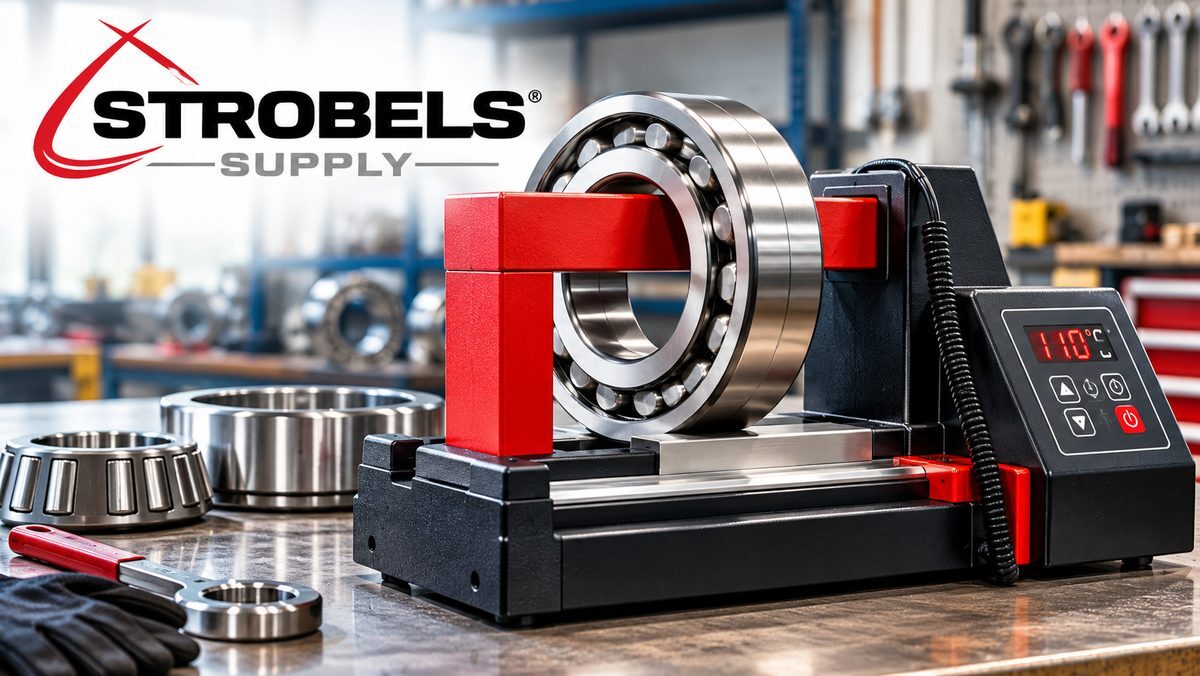
How an Induction Bearing Heater Works
The heater uses a coil and a steel yoke (the cross bar) to create an alternating magnetic field. The bearing sits on the yoke and becomes part of the circuit, so electric currents are induced inside the bearing steel and heat it from within. The heater itself stays cool, and heating is fast, even and controlled by a temperature probe or timer. The same method works on gears, sprockets, couplings, pulleys and sleeves.
Induction vs. other heating methods
| Method | Problems |
|---|---|
| Torch or open flame | Uneven heat, risk of cracking or distorting the ring, no temperature control |
| Oil bath | Slow, contaminates the bearing, and hot oil is a burn and fire hazard |
| Hot plate | Heats from one side, so the ring can distort; slow on larger bearings |
| Oven | Even heat but slow, and not suitable for sealed or pre-greased bearings |
| Induction heater | Fast, even, clean and temperature-controlled |
What Temperature Should You Heat a Bearing To?
For most mounting jobs, heating the bearing about 80 to 90°C (roughly 145 to 160°F) above the shaft temperature gives enough expansion for an easy slide fit. Always stay under the bearing's limit:
- Open bearings: generally no more than 120°C (248°F)
- Sealed and pre-greased bearings: generally no more than 80°C (176°F), to protect the seals and grease
Limits vary by bearing design, so check the bearing manufacturer's recommendation. Use the heater's temperature probe on the inner ring rather than guessing, and let the bearing cool naturally on the shaft. Never quench it with water or air.
How to Choose an Induction Bearing Heater
Size the heater by the parts you mount most often. The key numbers are:
- Maximum outside diameter (OD). This is the largest bearing or gear that fits around the coil.
- Maximum width. This is the widest part that fits between the yoke and the base.
- Minimum bore. This is set by the smallest cross bar. The bar should fill as much of the bore as possible for the fastest heating.
- Power supply. Portable 120V units plug into a standard outlet. Larger units run on 220V, 440V or 550V.
- Controls. Digital temperature and time settings, plus automatic demagnetization, make results repeatable.
BESSEY induction bearing heaters at Strobels Supply
| Model | Bearing capacity | Best for |
|---|---|---|
| Smart Portable (120V or 230V) | Table-top unit | Maintenance shops: digital temperature and time setting, automatic demagnetization |
| SC model | Up to 11 in. OD and 4 in. wide (14 in. OD with optional raising blocks) | Small and medium bearings, gears and couplings |
| BC model (440V or 550V) | Up to 22 in. OD and 7-1/2 in. wide (32 in. OD with raising blocks) | Large bearings and heavy industrial use |
| BCS model (220V or 440V) | Up to 22 in. OD and 11-1/2 in. wide | Wide bearings, sleeves and gears |
Replacement cross bars from 3/4 in. to 3 in. are available for BC and BCS units, so one heater can cover a wide range of bores. See the full range in our induction bearing heaters category.
How to Use an Induction Bearing Heater
- Check the bearing and shaft. Make sure both are clean, and measure the shaft to confirm the fit.
- Pick the largest cross bar that fits the bore and place the bearing on it, centered on the coil.
- Attach the temperature probe to the inner ring and set the target temperature, or the time for repeat jobs.
- Start the cycle. The heater stops at the set point and, on models with automatic demagnetization, removes residual magnetism.
- Wear heat-resistant gloves, lift the bearing off, and slide it onto the shaft in one smooth motion, square against the shoulder.
- Hold it in place while it cools so it doesn't pull away from the shoulder as it shrinks.
Common Mistakes to Avoid
- Overheating. Going past the bearing's temperature limit can change the steel's hardness and ruin the grease and seals.
- Skipping demagnetization. A magnetized bearing attracts metal particles that wear the raceways.
- Using a bar that's too small. Heating is slower and less even.
- Heating with a torch "just this once". Hot spots can crack the ring or distort the raceway.
FAQ
Can an induction heater remove bearings too?
It can help remove parts like gears, couplings and inner rings by expanding them quickly before the shaft heats up. Large, tight removals often need a dedicated removal tool.
Does an induction bearing heater work on non-bearing parts?
Yes, on any ferrous ring-shaped part, including gears, sprockets, pulleys, couplings and sleeves.
Do I need a 220V outlet?
Not for small and medium bearings. Portable models such as the BESSEY Smart heater run on standard 120V power.
Not sure which heater fits your bearings? Shop BESSEY induction bearing heaters or contact our team with your bearing size.