
 US Dollars
Abrasive Brushes: Types, Grits & When to Use Them
Apr 28th 2026
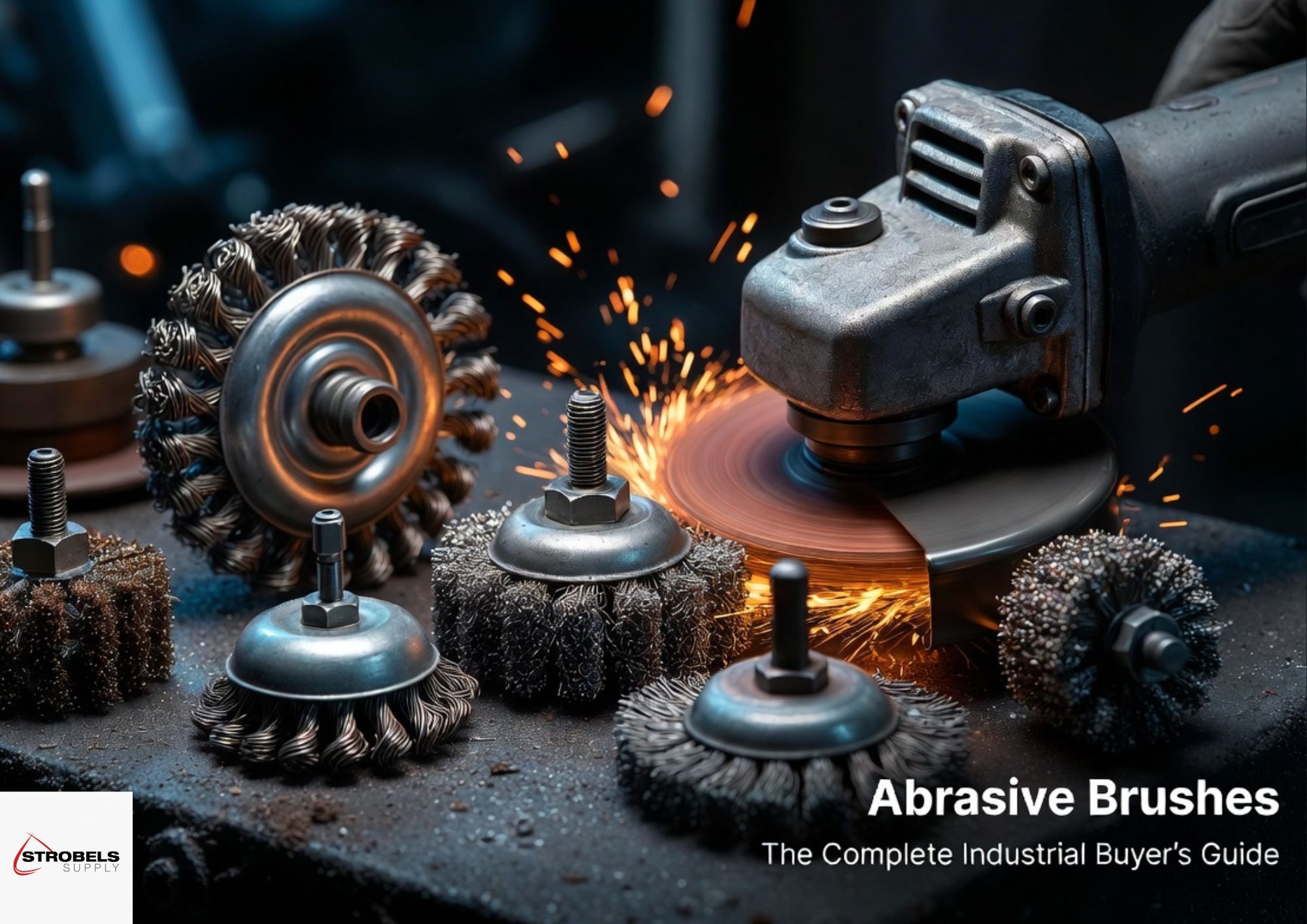
Abrasive Brushes: Complete Industrial Guide to Selection, Applications & Safety
Deburring | Surface Prep | Weld Cleanup | Honing | Polishing | Finishing
Table of Contents
- Part 1: Abrasive Brush Basics
- Part 2: Types of Abrasive Brushes — By Construction and Form Factor
- Part 3: Tools, Applications, and Material-Specific Guidance
- Part 4: Cleaning, Maintenance, Safety, and Health
- Frequently Asked Questions (FAQ)
- Conclusion: A Practical Decision Framework
Part 1: Abrasive Brush Basics
What Are Abrasive Brushes? Definition, How They Work, and Key Components
An abrasive brush is a rotary or reciprocating tool in which abrasive-laden filaments, wires, or impregnated bristles perform material removal, surface conditioning, deburring, cleaning, or finishing through repeated, controlled contact with a workpiece.
Unlike rigid grinding wheels or belts, abrasive brushes use the flexing, sweeping action of individual filaments. This flexibility allows them to reach into slots, ports, cross-drilled holes, and complex contours that rigid tools cannot access.
Key Components of an Abrasive Brush
- Filament or bristle: The working element (wire, nylon — unfilled or abrasive-impregnated, or specialty materials). Diameter, stiffness, and abrasive content control cut rate and finish.
- Fill material / abrasive: In impregnated nylon brushes, grains (silicon carbide, aluminum oxide, diamond, zirconia) are distributed throughout the filament. Fresh abrasive exposes as the tip wears — delivering consistent performance.
- Core or hub: The structural base (steel or aluminum hub with arbor hole, or metal channel for strip brushes).
- Shank or arbor: The interface to the power tool (1/4" hex/round shank, 5/8-11 threaded arbor, or CNC tool holder).
Main Functions: What Abrasive Brushes Actually Do
|
Function |
What It Does |
Typical Workpieces |
|
Deburring |
Removes sharp edges, burrs, and flash |
Machined castings, drilled holes, stamped parts |
|
Edge Radiusing |
Creates controlled, repeatable edge radii |
Aerospace blades, medical implants, valves |
|
Surface Preparation |
Opens surface profile, removes scale/oxides/coatings |
Weld zones, forgings, castings before coating |
|
Cleaning & Descaling |
Removes rust, mill scale, weld spatter, deposits |
Structural steel, pipe, heat-treated parts |
|
Finishing & Blending |
Produces uniform lay, grain, or matte finish |
Stainless panels, aluminum extrusions |
Abrasive Materials and Filaments — What Your Brush Is Made Of
Nylon with Abrasive Grit (Impregnated Nylon)
The backbone for precision work. Abrasive grains are embedded throughout the nylon filament for self-sharpening action.
- Silicon carbide (SiC): Sharper, ideal for aluminum, titanium, composites, wood grain enhancement.
- Aluminum oxide (AO): Tougher, good for steel and stainless; finer finish at equivalent grit.
- Common grits: 46, 80, 120, 180, 240, 320, 400 (and finer for polishing).
Wire Filaments
Aggressive scratch-cutting and impact.
- Carbon steel wire: Most aggressive; use only on carbon steel/cast iron.
- Stainless steel wire (302/316): Required for stainless to avoid contamination.
- Brass wire: Soft, non-sparking, for sensitive or flammable environments.
- Wire diameter: Finer (0.003") for lighter finish; heavier (up to 0.020") for aggressive removal.
Diamond Filaments
For extreme hardness (carbide, ceramics, glass, hardened steel). Available in electroplated or resin-bond formats.
Zirconia Alumina Filaments
Self-fracturing grain for longer life on stainless, high-alloy steels, and superalloys. Excellent for reducing changeover frequency.
Plastic and Composite Filaments
Polypropylene or polyester alternatives for chemical resistance in wet environments.
TCO Note: A higher-priced zirconia nylon brush that lasts longer often delivers lower cost-per-part than cheap alternatives due to reduced labor and downtime.
Part 2: Types of Abrasive Brushes — By Construction and Form Factor
By Construction Type
- Nylon Abrasive Brushes (Impregnated): Dominant for precision deburring, honing, and finishing. Ideal for CNC, robotic, and automated lines.
- Wire Brushes: Best for heavy rust/scale/weld spatter removal. Aggressive but produce less controlled finishes.
- Impregnated Nylon vs. Wire — The Core Decision:
|
Factor |
Impregnated Nylon |
Wire |
|
Primary Action |
Abrasion + flexibility |
Scratch-cutting + impact |
|
Surface Finish |
Controlled, consistent Ra |
Aggressive, directional scratches |
|
Workpiece Safety |
High (low risk of embedment) |
Moderate (possible embedment) |
|
Best Use |
Deburring, honing, finishing |
Heavy cleaning, weld cleanup |
|
Contamination Risk |
Low |
Higher |
|
Life Expectancy |
Long (self-sharpening) |
Shorter (shedding/breakage) |
- Strip Brushes: Filaments in a metal channel for conveyors, deburring machines, and edge sealing.
By Form Factor — A Complete Reference
|
Form Factor |
Shape & Mount |
Typical Applications |
Speed Range |
|
Cup Brushes |
Cup-shaped, arbor or 5/8-11 thread |
Large flat surfaces, weld zones, rust removal |
Up to 6,000–10,000 RPM |
|
Wheel Brushes |
Flat disc, center bore |
Edge work, slots, bench grinding |
Up to 6,000–12,000 RPM |
|
End Brushes |
Cylindrical with shank |
Holes, ports, blind bores, tight spaces |
Up to 20,000–30,000 RPM |
|
Cylinder/Roller |
Wide cylinder on shaft |
Automated lines, large panels |
Application-specific |
|
Ball Brush |
Spherical |
Curved/3D surfaces, molds |
Up to 25,000 RPM |
|
Tube/Bottle |
Twisted core, radial filaments |
Internal pipe/tube/bore cleaning |
Low/manual |
|
Radial Wheel |
Flat disc with radial projection |
Edge deburring, weld blending |
Up to 10,000 RPM |
Non-Abrasive vs. Abrasive Brushes
Abrasive brushes actively remove or modify material (impregnated nylon or wire). Non-abrasive brushes (soft nylon, natural fiber) clean without altering the substrate. Always match the specification — using an abrasive brush where “non-abrasive” is called for causes non-conformance.
Part 3: Tools, Applications, and Material-Specific Guidance
Tool-Specific Guide
- Drill and Rotary Tool Brushes: 1/4" shank for handheld use; rated 3,000–4,500 RPM.
- Dremel and Rotary Tool Brushes: High-speed (up to 35,000 RPM), small diameters for intricate detail work.
- Angle Grinder Brushes (5/8-11 Threaded Arbor): Workhorses for fabrication; wire cup/wheel styles common.
- Brush Sanders: For contoured wood or panel finishing.
Material-Specific Application Guide
- Carbon Steel / Structural Steel / Cast Iron: Wire brushes for weld cleanup and scale removal; nylon for precision deburring.
- Stainless Steel: Stainless wire or nylon only — never carbon steel (contamination risk). Dedicate and segregate tools.
- Aluminum: Silicon carbide nylon; lower RPM and lubricant to prevent loading.
- Titanium: Silicon carbide nylon with coolant; avoid wire due to fire/sparking risk.
- Wood: Nylon or wire for grain enhancement, paint stripping, and texturing.
- Concrete/Masonry/Stone: Wire or diamond for cleaning and texturing.
- Plastics/Composites: Fine-grit silicon carbide nylon at low speed to avoid melting.
Wire Brush vs. Sandpaper
Use wire/nylon brushes for heavy removal and access to profiles; follow with sandpaper for precise leveling and fine finish. For precision parts, impregnated nylon often replaces both.
Part 4: Cleaning, Maintenance, Safety, and Health
Cleaning and Maintaining Abrasive Brushes
- Removing Loading: Use dressing sticks for nylon; tap hub for wire; flush tube brushes.
- Inspection: Check for broken/kinked wires, worn filaments (<50% trim length), hub cracks.
- Storage: Dry environment; hang wire brushes to prevent deformation.
- When to Replace: Worn filaments, visible damage, or after overspeeding.
Safety Guidelines — Protecting Your People
- PPE Minimum: ANSI Z87.1 safety glasses + face shield, hearing protection, cut-resistant gloves, respirator as needed.
- Technique: Light-to-moderate pressure; correct angle (5–15° for cup/wheel); never exceed max RPM.
- Bristle Shedding: Normal with wire; managed via PPE and housekeeping. Restrict wire brushes in food/pharma due to contamination risk.
- Damaged Brush Risks: Discard if wires protrude, hub is cracked, or brush has been overspeed/dropped.
Teeth, Hair, Skin, and Grooming
Industrial abrasive brushes are not for personal care. They are too aggressive for teeth, skin, or hair and can cause damage. Use only dentist-recommended ultra-soft brushes for oral care. Ceramic grits pose no chemical toxicity in industrial use with proper PPE — the main hazard is dust inhalation.
Frequently Asked Questions (FAQ)
What is the difference between an abrasive brush and a wire brush?
A wire brush is a type of abrasive brush using metallic wire. Broader abrasive brushes include impregnated nylon (with SiC/AO/diamond grit) for controlled finishing.
Can I use the same abrasive brush on both carbon steel and stainless steel?
No. Carbon steel wire contaminates stainless, causing rust. Use dedicated stainless wire or nylon brushes for stainless and segregate tools.
What does "loaded" mean, and what do I do about it?
Loading is clogging of filaments with debris, reducing performance and causing heat/smearing. Dress with a stick (nylon) or tap the hub (wire); reduce RPM/pressure if recurrent.
How do I know when an abrasive brush needs to be replaced?
When filaments wear to 40–50% original length, grit is gone from tips, wires are kinked/broken, or performance drops. Discard any oversped brush.
What grit should I use for deburring machined steel parts?
Start with 120-grit silicon carbide or aluminum oxide nylon. Use 80-grit for heavy burrs, then finer for finish/radius.
What is the correct RPM for an abrasive brush?
Always match or stay below the brush’s labeled maximum safe free speed (MSFS). Check tool no-load RPM against brush rating.
Should I use a cup brush or a wheel brush?
Cup for large flat surfaces and fast prep; wheel for edges, slots, and bench work.
What is the best abrasive brush for deburring aluminum?
Silicon carbide impregnated nylon at reduced RPM with light lubricant to minimize loading.
Can abrasive brushes be used in CNC machining centers?
Yes — nylon disc/wheel brushes (e.g., NamPower-style) are designed for automatic tool changers with proper programming.
Are abrasive brushes covered by OSHA regulations?
Yes — under OSHA 1910.215 and 1910.243. Operate within rated RPM, use guards, and provide training.
What PPE is required when using a wire cup brush on an angle grinder?
Safety glasses + full face shield, hearing protection, cut-resistant gloves, and respirator where dust is generated.
Can wire fragments from a brush contaminate a food processing facility?
Yes, a significant foreign material risk. Use nylon brushes instead in food/pharma environments.
What should I do if a wire brush exceeds its rated RPM accidentally?
Stop immediately, discard the brush (internal fatigue may be invisible), inspect the tool, and document the incident.
How do I calculate the true cost per part for an abrasive brush?
(Brush cost ÷ parts per brush life) + (changeover labor cost per change ÷ parts per brush). Factor in downtime and quality impact.
What brush specifications should I require from suppliers?
Max RPM (certified), filament material/grit/diameter, trim length, hub specs, SDS, and lot consistency data.
Conclusion: The Right Brush for Every Job
Abrasive brushes are precision tools — not just "wire brushes" or "scrub brushes". The difference between a knotted carbon steel wire cup brush on an angle grinder and a 180-grit silicon carbide impregnated nylon wheel brush on a die grinder represents entirely different capabilities, finishes, and applications. Getting the choice right means better results, safer operation, and lower total cost.
The key principles to remember:
- Match filament type to material: Wire for aggressive metal cleaning; abrasive nylon for controlled finishing and deburring; diamond for very hard materials.
- Match form factor to geometry: Cup for flat surfaces; end brush for cavities; cylinder for production lines; tube brush for bores.
- Match grit to stage: Coarse for bulk removal; medium for blending; fine for finishing and surface conditioning.
- Respect RPM ratings: Always confirm your brush is rated at or above your tool's speed this is a safety non-negotiable.
- Inspect before every use: Replace brushes showing wire loss, corrosion, or structural damage.
Need Help Selecting the Right Brush?
Strobels Supply carries a comprehensive range of abrasive brushes, wire brushes, and abrasive accessories for metalworking, woodworking, automotive, and industrial applications. Visit strobelssupply.com or contact our team for expert product selection support.