
 US Dollars
How to Choose the Right Industrial Water Filter Cartridge
May 18th 2026
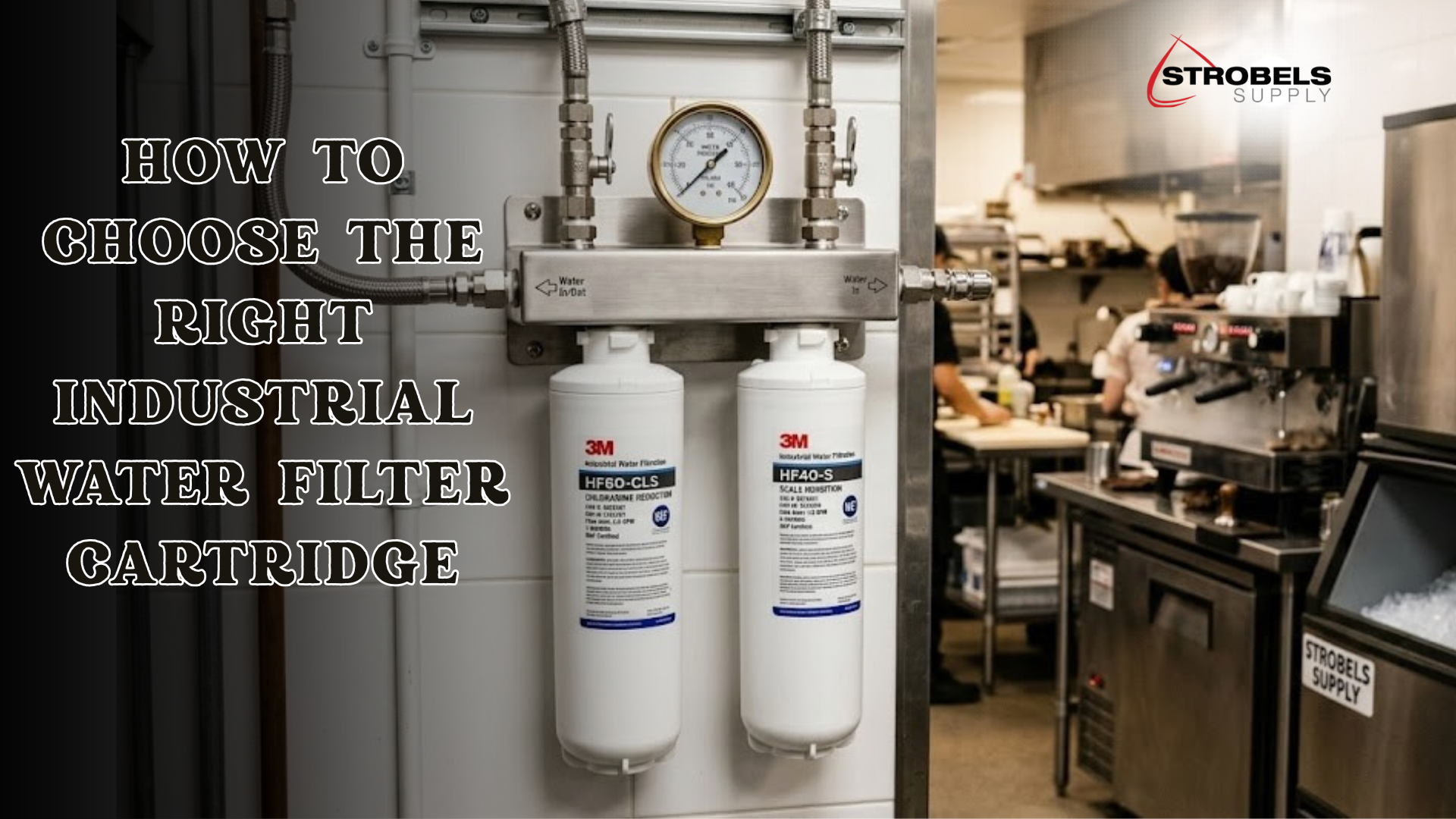
How to Choose the Right Industrial Water Filter Cartridge
Choosing the right industrial water filter cartridge comes down to four specs: the micron rating (what particles you need to remove), the flow rate (how much water moves through it), the housing compatibility (whether the cartridge physically fits your head), and the replacement schedule (how long it lasts at your usage). For most foodservice and light industrial applications, a 5-micron carbon block cartridge in the 3M HF series, sized to handle 1.5–5 GPM, will fit standard equipment. The right pick for your operation depends on your water test results and equipment manufacturer specs.
Why Filter Selection Matters More Than Most Operators Realize
A wrong cartridge doesn't just underperform. It shortens equipment life, voids manufacturer warranties, and lets contaminants reach equipment they should never touch. A misseated 1-micron cartridge on a high-volume rinse line plugs in days. A standard chlorine cartridge on a chloraminated municipal supply passes contaminants through carbon that can't grab them. A correctly-sized cartridge in the wrong housing series leaks at the seal.
The four specs below are the difference between a filter that protects your equipment for 12 months and one that costs you a service call within 90 days.
Spec 1: Match the Micron Rating to the Contaminant
The micron rating tells you the smallest particle the cartridge can capture. Lower numbers mean smaller particles caught — and that comes with trade-offs in flow rate, cartridge life, and pressure drop. Lower is not always better.
Micron rating reference table
| Micron Rating | Catches | Best Used For |
|---|---|---|
| 20–50 micron | Sand, silt, scale chunks, large sediment | Pre-filtration ahead of fine filters, well water, sediment-only protection |
| 5–10 micron | Rust, fine sediment, cyst protection | General industrial process water, foodservice equipment, baseline protection |
| 1–5 micron | Cysts (Cryptosporidium, Giardia), fine particulates | Foodservice, beverage, ice machines, steamers |
| 0.2–1 micron | Bacteria, ultra-fine particles | Pharmaceutical rinse water, lab applications, polishing stages |
| Sub-micron carbon block | Chlorine, taste, odor, VOCs, lead, chloramine (with -CL) | Drinking water, ice quality, beverage clarity |
How to choose without a water test
If your equipment manual specifies a micron rating, match it exactly. Most commercial ice machines spec 5-micron. Most combi ovens spec 5-micron with scale inhibition. Most espresso machines spec 1-micron with carbon block.
If no spec is listed, the rule of thumb is:
- Sediment-only problem (visible particles, sandy water): 20–50 micron
- General foodservice / equipment protection: 5 micron
- Taste, odor, beverage quality: 1–5 micron carbon block
- Sensitive process water (pharma, lab): 0.2–1 micron
Common mistake to avoid
Operators often default to the finest filter "just to be safe." This costs money and doesn't add protection. A 1-micron cartridge on raw well water plugs within weeks because it's catching particles a 20-micron pre-filter should have caught upstream. Use coarse pre-filtration first, then step down to fine filtration only where the application requires it.
Spec 2: Size the Cartridge to Your Actual Flow Rate
A cartridge undersized for your flow becomes a bottleneck. Pressure drops, equipment downstream starves, and in the worst cases the cartridge collapses. To size correctly, you need two numbers: peak demand and acceptable pressure drop.
How to calculate peak flow rate
Peak demand is the maximum gallons-per-minute (GPM) your system draws — not the average. A coffee shop espresso machine might idle at 0.5 GPM but spike to 3 GPM during the morning rush. Spec the cartridge for the spike.
To estimate peak GPM, add the maximum simultaneous draw of every piece of equipment downstream of the filter:
| Equipment | Typical Peak Draw |
|---|---|
| Single ice machine (under-counter) | 0.5–1.5 GPM |
| Commercial ice machine (modular) | 2–5 GPM |
| Espresso machine (3-group) | 1.5–3 GPM |
| Combi oven | 1–3 GPM |
| Commercial dishwasher | 2–6 GPM |
| Coffee brewer (batch) | 1–2 GPM |
| Beverage dispenser (post-mix) | 1–2 GPM |
If your peak load is 4 GPM, you need a cartridge rated for at least 4 GPM at acceptable pressure drop — typically 5 GPM rated for headroom.
3M cartridge series by flow rate
| Series | Typical Flow Range | Best Application |
|---|---|---|
| HF Series (High Flow) | 1.5–5 GPM | Foodservice, ice machines, single-equipment |
| BREW Series | 1.67–3.34 GPM | Coffee, espresso, beverage |
| Scale-Inhibiting Series | 1.5–6 GPM | Combi ovens, steamers, dishwashers |
| Multi-Cartridge Manifolds | 5–25+ GPM | Multi-equipment, restaurant chains, light manufacturing |
When to step up to a manifold
If your peak load exceeds 5 GPM, do not just buy a bigger single cartridge. Move to a parallel manifold with two or three smaller cartridges. A two-cartridge manifold cuts pressure drop in half and doubles capacity without changing the micron rating. It also lets you replace one cartridge at a time without taking equipment offline.
Spec 3: Verify Housing Compatibility Before You Order
This is where most ordering mistakes happen. A cartridge that looks identical to the one you replaced last year may not seat properly in your housing — and a misseat is worse than no filter, because water bypasses the media entirely.
Three things must match
1. Cartridge series and housing series. 3M groups cartridges into housing-specific families. An HF20 cartridge fits an HF20 head. It will not seat in an HF40 head, even though both are 3M and both are foodservice-grade. Match the first letters and the number prefix.
2. Connection type and size. Inlet/outlet connections are typically 3/8" or 3/4" NPT, push-fit, or sanitary tri-clamp. A push-fit head will not accept an NPT-stem cartridge.
3. Mount style — bayonet vs. twist-in. Older 3M housings often use a bayonet mount with an O-ring seal. Newer models use a twist-in mount. The cartridge ends are not interchangeable between the two, even within the same series.
How to verify before you buy
Before ordering a replacement, check the existing cartridge label and the housing label. If either is illegible:
- Photograph the cartridge from three angles, including the end cap
- Photograph the housing label and the connection ports
- Send both to your distributor for cross-reference
This takes about 90 seconds on the distributor side and saves the cost of restocking the wrong part. If you also have the equipment make and model, that's a third confirmation point.
Cuno and Aqua-Pure legacy housings
3M acquired Cuno in 2005, and many older installations still run Cuno- or Aqua-Pure-branded housings. The current 3M-branded equivalent cartridge almost always exists, but the cross-reference isn't always obvious from the part number. Common examples:
| Legacy Cuno Part | Current 3M Equivalent |
|---|---|
| CFS9112 | HF20 |
| CFS9812X | HF60 |
| CUNO BEV-130 | BEV130 |
| AP517 | AP517 (naming retained) |
If your housing is more than 10 years old, confirm the cross-reference before assuming the new 3M part number works.
Spec 4: Set a Replacement Schedule You'll Actually Follow
Every 3M industrial cartridge has a rated capacity, usually expressed in gallons. That number assumes typical municipal water. If your feed water is high-sediment, high-hardness, or chlorinated above municipal averages, you'll hit end-of-life sooner.
Three replacement triggers — use whichever comes first
1. Gallons used. Best for predictable, metered applications. Install a flow meter on the filter manifold and replace at 80–90% of rated capacity.
2. Pressure differential. Install gauges before and after the filter. When the drop exceeds 15 PSI (or whatever your equipment manual specifies), replace regardless of gallons. A growing pressure drop means the cartridge is loading with sediment.
3. Time elapsed. Even at low usage, replace carbon-based cartridges every 6–12 months. Carbon binds organics whether water is flowing or not, and bacterial growth in stagnant carbon is a real risk.
Practical replacement intervals by application
| Application | Typical Replacement Interval |
|---|---|
| Single ice machine | Every 6 months |
| Multi-equipment foodservice manifold | Every 6 months (or per gallon meter) |
| Combi oven / steamer (scale-inhibiting) | Every 6 months |
| Coffee / espresso | Every 3–6 months |
| Industrial process pre-filter | Quarterly inspection, replace as loading dictates |
| Beverage dispenser | Every 6 months |
Set a recurring calendar reminder. The cost of an early replacement is the cost of a cartridge. The cost of a late replacement is a service call, a damaged compressor, or a discarded production batch.
Common Mistakes That Cost More Than the Cartridge
These five mistakes account for most of the costly filter problems we see in industrial accounts.
1. Buying generic "compatible" cartridges to save money. Generics are often a half-millimeter off in seating depth, which causes partial bypass. The savings vanish the first time a board fails downstream.
2. Ignoring the water test. A $50 commercial water test up front saves four wrong cartridge orders later. Without a test, you're guessing about hardness, chloramine, iron, and TDS.
3. Mixing cartridge series across a manifold. All cartridges in a parallel manifold should be identical. Mixed micron ratings cause uneven loading, unpredictable flow distribution, and inconsistent treatment.
4. Skipping the pre-filter. Running a 1-micron polishing cartridge on raw well water is a great way to spend $200/month on cartridges that should last $200/year. Always pre-filter coarse material upstream.
5. Forgetting to flush after replacement. Always flush 5–10 gallons through a new cartridge before putting equipment back in service. Carbon fines and packing dust will otherwise end up in your first batch of product.
When to Step Up to Industrial-Grade
If you're a small commercial operator (food truck, micro-roaster, microbrewery, small manufacturing line), you may be running residential-grade filters past their useful life. Five signs your operation has outgrown residential filtration:
- Cartridges plugging in less than half their rated life — your usage exceeds the design assumption
- Pressure drops faster than expected — flow rate exceeds the cartridge spec
- Recurring scale on equipment despite filtration — you need scale inhibition, not just sediment removal
- Water taste/quality complaints from customers — fine filtration or chloramine reduction is needed
- Equipment service calls citing water quality — a stronger filter prevents the next call
If any two of these apply, move from a single residential cartridge to a 3M HF or scale-inhibiting commercial cartridge in a properly-sized housing.
Frequently Asked Questions
What micron rating do I need for an industrial water filter?
For most industrial and commercial foodservice applications, a 5-micron cartridge provides effective sediment, rust, and cyst protection without restricting flow. Use 1-micron for beverage and ice quality where fine particulates matter, and 20-50 micron for sediment-heavy pre-filtration.
How often should I replace an industrial water filter cartridge?
Replace every 6 months for most foodservice equipment, or sooner if pressure drop exceeds 15 PSI or you've used 80–90% of the cartridge's rated gallon capacity. Coffee and espresso applications often replace every 3–6 months due to taste sensitivity.
What's the difference between 3M HF20 and HF40 cartridges?
HF20 is rated for approximately 9,000 gallons at 1.5 GPM and fits a smaller housing. HF40 is rated for approximately 24,000 gallons at 1.5 GPM and fits a larger housing. The cartridges are not interchangeable — the housings are different sizes. Choose based on your equipment manufacturer's spec or your usage volume.
Can I use the same filter for hard water and chlorinated water?
Only if the cartridge is specifically rated for both. A standard carbon cartridge handles chlorine but not scale; a scale-inhibiting cartridge (-S or -MS suffix) handles hardness but may not address chloramine. For hard, chloraminated water, look for a -CLS or -CLM suffix, which combines chloramine reduction with scale inhibition.
Do I need a water softener AND a water filter?
Not always. A water softener uses ion exchange to remove hardness minerals (calcium, magnesium) at scale. A filter cartridge with scale inhibition (-S or -MS) uses polyphosphate sequestration to keep minerals in solution and prevent them from depositing — without the regeneration cycle of a softener. For light commercial use, scale-inhibiting filtration is often enough. For heavy industrial use or very hard water (above 15 grains per gallon), a softener plus filter combination is more cost-effective.
Why is my new water filter causing low pressure?
Three common causes: the cartridge is undersized for your flow rate, the housing is the wrong series, or the cartridge wasn't seated correctly. Check the GPM rating against your actual peak demand, verify the housing series matches the cartridge series, and confirm the cartridge twisted or seated to the correct stop position.
Are aftermarket cartridges as good as 3M OEM?
Aftermarket quality varies widely. Higher-end aftermarket cartridges from established water treatment brands can match OEM performance at lower cost. Lower-end aftermarket cartridges often skimp on carbon weight, gasket material, or micron consistency — savings disappear when equipment downstream fails. For warranty-covered equipment, OEM is safer; for out-of-warranty applications, vetted aftermarket can make sense.
How do I read a 3M water filter part number?
A 3M part number has three parts: a series prefix (HF, BREW, ICE, BEV, AP), a capacity number, and an optional suffix (-S for scale, -CL for chloramine, -MS for maximum scale). For example, HF20-MS means High Flow series, size class 20, with maximum scale inhibition.
Get the Right Cartridge the First Time
Strobels Supply stocks the full 3M industrial water filtration catalog HF, BREW, ICE, BEV, scale-inhibiting, high-flow manifolds, and replacement cartridges for legacy Cuno and Aqua-Pure housings most distributors stopped carrying years ago.
If you have a part number, we can confirm fit and ship same-day. If you only have an equipment make and model and a problem ("my ice machine is scaling," "my espresso shots are inconsistent," "my dishwasher leaves spots"), send us the details and we'll spec the system.