
 US Dollars
Custom Abrasives: When Standard Grits Won't Work
Apr 28th 2026
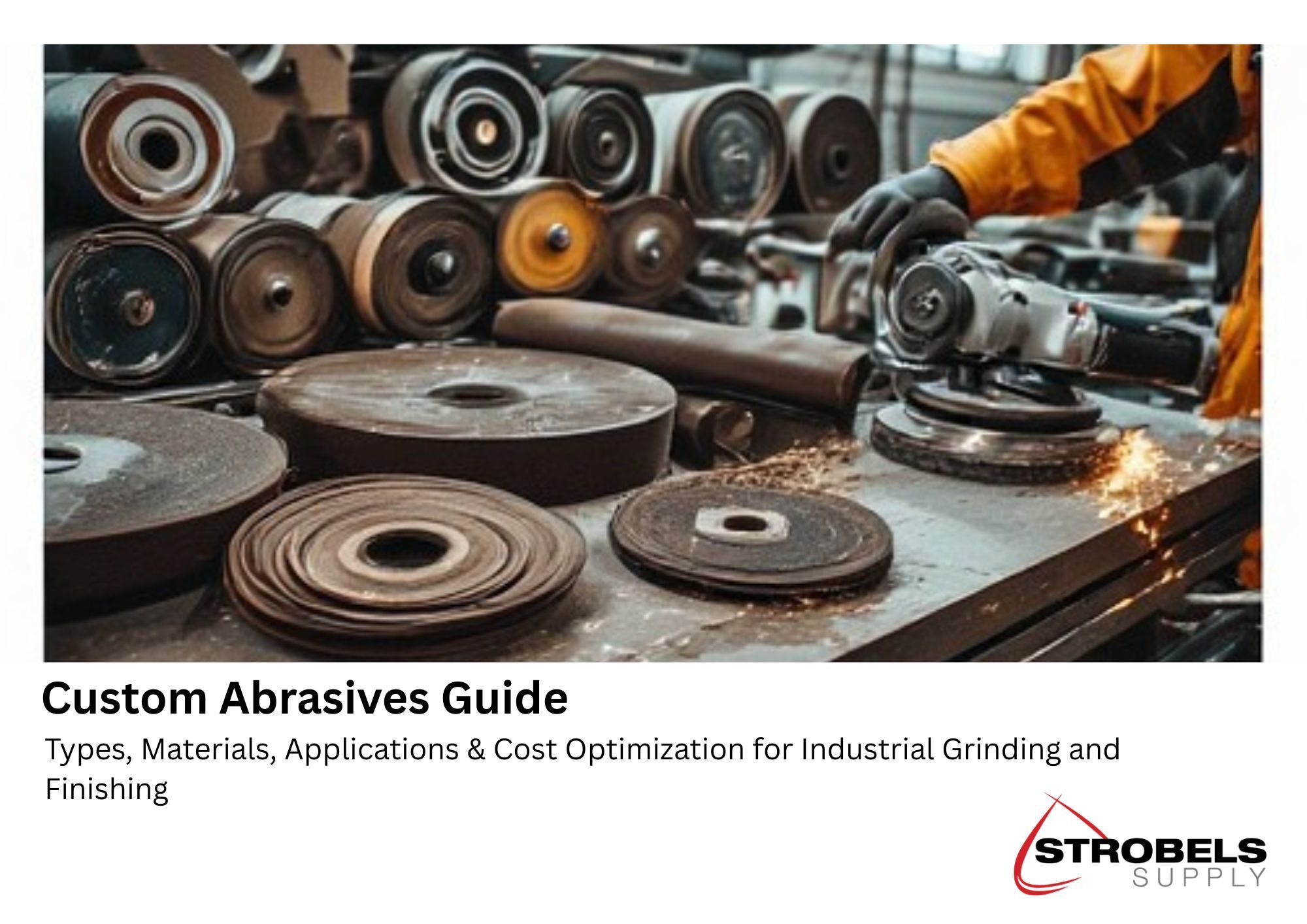
Custom Abrasives: Complete Guide to Types, Materials, Applications & Cost-Per-Part Optimization
By Strobels Supply Technical Team | Industrial Abrasive Specialists since 1940
Custom abrasives are made-to-order abrasive products belts, discs, wheels, or sheets engineered to specific dimensions, grain types, grit sequences, and backing weights that standard off-the-shelf products cannot match. Industrial shops use them when machines run non-standard sizes, when materials demand a specific grain-bond combination unavailable in catalog products, or when production volume justifies optimizing cost-per-part through a purpose-built abrasive. Custom abrasives are manufactured using the same core materials as standard products aluminum oxide, zirconia, ceramic, silicon carbide, and diamond but specified, cut, and joined to exact customer requirements.
Table of Contents
- What Are Custom Abrasives?
- Custom Abrasive Products: Belts, Discs, Wheels, and More
- How Custom Abrasives Are Made
- When to Choose Custom vs. Standard Abrasives
- Custom Abrasives by Material: Aluminum, Stainless, Wood, Concrete, and More
- Grain Types for Custom Abrasives: Which Material Does What
- Custom Abrasive Backing Options Explained
- How to Order Custom Abrasives: What You Need to Know
- Are Custom Abrasives Worth It? A Cost-Per-Part Analysis
- Quality, Safety, and Certifications for Custom Abrasives
- FAQ: Custom Abrasives
1. What Are Custom Abrasives?
A custom abrasive is any coated or bonded abrasive product manufactured to specifications that fall outside standard catalog dimensions, grain formulations, or configurations. The term covers a broad range of products: a sanding belt cut to a non-standard width for a legacy wide-belt sander, a grinding wheel engineered for a specific alloy with a matched bond hardness, or a set of fiber discs specified with a ceramic grain at a grit not available in stock.
Custom abrasives are not a niche product. They are used routinely across metalworking, woodworking, aerospace, automotive manufacturing, construction fabrication, and transit maintenance — any environment where a standard product either does not fit the machine or does not deliver the surface finish and tool life required by the production spec.
At Strobels Supply, we have been sourcing and specifying industrial abrasives for manufacturing, transit, and construction customers across the region for over 80 years. In that time, the question we hear most often is a version of: "I can't find a belt in this size" or "Nothing off the shelf is holding up on this material." Custom abrasives are the answer to both.
2. Custom Abrasive Products: Belts, Discs, Wheels, and More
Custom Abrasive Belts
Custom sanding and grinding belts are the most commonly ordered custom abrasive product. Standard belt sizes cover most modern machine configurations, but there are countless situations where a custom belt is required:
- Legacy machines with non-standard platen or contact wheel dimensions
- Wide-belt sanders in furniture and panel production that require belts wider than standard catalog offerings
- Knife-making and specialty grinding where 2×72 inch is standard but alternative lengths are needed for specific machine builds
- Industrial production equipment where belt dimensions are designed around the process, not around standard catalog sizes
Custom belts are built with the same components as standard belts: a backing material (paper, cloth, film, or combination), a make coat that anchors the grain, abrasive grain, and a size coat that locks grain in place. The joint — the splice where the belt ends meet — is specified as either a butt joint or a lap joint depending on the application, machine speed, and grain direction requirements.
Common custom belt specifications include:
| Specification | Options |
|---|---|
| Width | Any width, typically 1" to 60"+ |
| Length | Any circumference |
| Backing weight | J-weight (light/flexible), K-weight (medium), X-weight (heavy/stiff), Y-weight (extra heavy) |
| Grain material | AO, silicon carbide, zirconia, ceramic, structured, non-woven |
| Grit | 24 through 2000 depending on grain type |
| Joint type | Butt joint, lap joint, Sheldahl splice |
| Coating | Open coat (resists loading), closed coat (maximum grain density) |
Custom Abrasive Discs
Custom discs are ordered when standard diameters (4.5", 5", 7") do not match tooling, when hole patterns are non-standard, or when a specific grain-grit-backing combination is unavailable as a catalog product. Custom fiber discs, film discs, and resin fiber discs are common in aerospace and automotive applications where surface finish specifications are tight and standard products cannot consistently hit the required Ra (surface roughness average).
Custom Abrasive Wheels
Bonded abrasive wheels can be custom manufactured to specific outer diameter, thickness, bore size, grade, structure, and bond type. Custom wheels are used in precision grinding operations — centerless grinding, cylindrical grinding, surface grinding — where the wheel geometry and bond specification directly control the part geometry and surface finish. Off-the-shelf wheels cannot always be matched to the machine setup, the material, and the coolant chemistry simultaneously.
Custom Finishing Media
Beyond belts, discs, and wheels, custom abrasive finishing media includes:
- Non-woven abrasive products (surface conditioning pads, cross pads, flap wheels) cut to non-standard sizes or grades
- Structured abrasive films for precision finishing of aerospace and medical components
- Diamond and CBN products built to specific bond formulations for tool grinding applications
- Custom zirconia and ceramic disc and belt combinations for high-pressure grinding on exotic alloys
3. How Custom Abrasives Are Made
Understanding how custom abrasives are manufactured helps you specify them correctly and evaluate quality when comparing suppliers.
Coated Abrasive Manufacturing Process
Step 1 — Backing preparation: The backing material (paper, cloth, polyester film, or vulcanized fiber) is prepared and conditioned. Cloth backings are calendered to smooth the surface; some are pre-treated with resin to control flexibility.
Step 2 — Make coat application: A liquid adhesive (the make coat — typically animal hide glue or synthetic resin) is applied to the backing. This is the layer that mechanically holds the abrasive grain.
Step 3 — Grain orientation (electrostatic coating): For coated abrasives, abrasive grain is applied electrostatically. An electric field orients angular grains so their sharp points face upward, away from the backing. This is what gives coated abrasives their cutting efficiency. Random orientation wastes grain and reduces cut rate.
Step 4 — Pre-cure: The make coat is partially cured to hold grain in place before the size coat is applied.
Step 5 — Size coat application: A second adhesive layer (the size coat) is applied over the grain to lock it firmly. The size coat also controls the abrasive's performance characteristics — a heavier size coat produces a harder-acting product; a lighter one allows more grain movement and a finer finish.
Step 6 — Final curing: The product is cured at controlled temperatures in ovens. Cure time and temperature affect bond strength and flexibility.
Step 7 — Flexing: Coated abrasive rolls are flexed — bent over a mandrel at controlled angles — to break the bond slightly and create a product with the correct flexibility for its intended use. Over-flexed products are too soft; under-flexed products crack in use.
Step 8 — Conversion: The large roll is cut, punched, or slit into the specified product form — belts, discs, sheets, or rolls. Belts are spliced and joined. Discs are punched with the correct hole pattern. This is the stage at which custom dimensions are produced.
Quality Control in Custom Abrasive Manufacturing
Reputable custom abrasive products should be manufactured to ANSI B74 standards (for bonded abrasives) and tested for grain size distribution, backing tensile strength, joint strength (for belts), and dimensional accuracy. Ask any supplier for their QA documentation and traceability records.
4. When to Choose Custom vs. Standard Abrasives
This is the practical question most shops face. The answer depends on four variables: machine fit, material, production volume, and finish requirement.
Choose Custom When:
Your machine runs a non-standard size. This is the most common reason. Older machinery, imported equipment, custom-built machines, and legacy production lines frequently use belt or disc dimensions not stocked by any distributor. A custom belt is the only option — and getting the joint type and backing weight wrong will cost you in belt life and machine wear.
Standard grain types are not performing. If you are burning through standard aluminum oxide belts on stainless steel, or if a standard resin-bonded wheel is glazing on a hardened steel application, the solution is not to buy more of the same product. It is to specify a different grain-bond combination. Zirconia and ceramic grains for aggressive steel applications, silicon carbide for non-ferrous and hard non-metallics, and diamond or CBN for precision tool grinding are combinations that may not be available in your required size as a stock product.
You are running high production volume. On average, the cost of abrasives for large metal fabrication firms is less than two percent of total cost, while the total cost of grinding and finishing is 10 to 15 percent. That means labor not the abrasive itself is the real cost driver. A custom abrasive that extends belt life by 40% and reduces changeover frequency directly reduces labor cost, which is always the larger number.
Your surface finish specification is tight. When Ra values are specified on engineering drawings, a standard abrasive may not hit them consistently across a production run. Engineered abrasive belts can last three to ten times the life of a conventional belt, and their consistent performance and longer life lower the cost per part. Custom-specified structured or engineered abrasives maintain consistent cut rate from start to finish of the belt life, which is critical for repeatable surface finish in aerospace, medical, and precision machined parts.
Stick with Standard When:
- Machine sizes match catalog dimensions exactly
- Production volume is low (one-off or occasional use)
- Surface finish requirements are general (no Ra specification)
- Material is common (mild steel, softwood) and responds well to standard AO products
- Budget is a hard constraint and lifecycle cost analysis is not feasible
5. Custom Abrasives by Material
The grain material and bond specification must match the workpiece material. Here is how custom abrasives are typically specified by material:
Aluminum
Aluminum loads standard abrasives rapidly. Aluminum particles weld to the abrasive grain through heat and pressure, filling the spaces between grains and stopping the cutting action. Custom abrasives for aluminum use:
- Open-coat construction to maximize the space between grains and delay loading
- Stearate (soap) coating (anti-loading treatment) to lubricate the interface and prevent grain clogging
- Silicon carbide grain for harder aluminum alloys
- Light-to-medium grit (80–150) for most general fabrication work
Stainless Steel
Stainless is both hard and work-hardening it becomes harder as you grind it, which destroys conventional aluminum oxide products quickly. Custom abrasives for stainless steel specify:
- Zirconia alumina grain (for high-pressure grinding and weld removal)
- Ceramic alumina grain (for sustained cut rate with lower heat generation)
- Iron- and sulfur-free formulations (contamination of stainless from abrasive residue causes corrosion the abrasive must be certified free of iron, sulfur, and chlorine per ANSI standards)
- Appropriate grit progression for specific finish requirements (#4 finish: 120–180 grit final pass; #8 mirror: progression to 400+ grit)
Carbon Steel and Mild Steel
The broadest application range. Standard aluminum oxide handles general work, but custom specifications add value through:
- Ceramic or zirconia grain for heavy stock removal (weld grinding, bevel preparation)
- Matched grit progressions for specific surface finish sequences
- Heavy backing weight for high-pressure applications on belt grinders
Aluminum Alloys, Titanium, and Exotic Metals
Aerospace and precision manufacturing materials require close attention to heat generation, contamination, and surface integrity. Custom abrasives for these applications specify:
- Ceramic grain with grinding aid to manage heat
- Controlled grit size and distribution for repeatable surface finish
- Non-contaminating bond formulations
Wood
Wide-belt sanding in furniture, flooring, and panel manufacturing is one of the highest-volume applications for custom abrasive belts. Custom specifications for wood include:
- Wide belt dimensions not available in catalog stock
- Aluminum oxide or ceramic AO for hardwoods
- Garnet or stearate-treated AO for finishing softwoods and preventing loading
- Paper or light cloth backing for flexibility over wide contact areas
Concrete and Stone
Custom diamond abrasive products are used for precision concrete finishing, stone fabrication, and masonry. Specifications include bond type (hard bond for soft materials, soft bond for hard materials), diamond concentration, and segment geometry for floor grinding or countertop fabrication.
6. Grain Types for Custom Abrasives: Which Material Does What
| Grain Type | Hardness (Mohs approx.) | Self-Sharpening | Best For | Avoid On |
|---|---|---|---|---|
| Aluminum Oxide (brown) | ~9 | No | Mild steel, wood, general use | Stainless, titanium (heat) |
| Aluminum Oxide (white) | ~9 | Moderate | Precision grinding, heat-sensitive materials | Heavy stock removal |
| Silicon Carbide | ~9.5 | Yes (very friable) | Aluminum, brass, cast iron, glass, ceramics, stone | Steel (too aggressive, short life) |
| Zirconia Alumina | ~9 | Yes (micro-fracture) | Stainless steel, carbon steel, heavy grinding | Fine finishing |
| Ceramic Alumina | ~9.2 | Yes (microcrystalline) | High-production steel, stainless, exotic alloys | Soft non-ferrous |
| Structured/Engineered | Varies | Controlled | Precision finishing, aerospace, medical, consistent Ra | High stock removal (not primary purpose) |
| Diamond (synthetic) | 10 | No | Carbide, ceramics, glass, composites, concrete | Ferrous metals (chemical reaction) |
| CBN (cubic boron nitride) | ~9.8 | No | Hardened steel, tool steel, cast iron | Non-ferrous metals, ceramics |
7. Custom Abrasive Backing Options Explained
The backing determines the abrasive's flexibility, strength, and suitability for wet vs. dry use.
Paper backings (A, C, D, E, F weight)
- A-weight: lightest, most flexible — hand sanding finish work
- C/D-weight: intermediate — orbital sanding, detail work
- E/F-weight: heavy — aggressive material removal with backing support
Cloth backings (J, K, X, Y weight)
- J-weight: light and flexible — contour sanding, irregular surfaces
- K-weight: medium — general belt sanding
- X-weight: stiff and strong — heavy grinding belts, high-pressure applications
- Y-weight: heaviest — aggressive grinding on industrial belt grinders and wide-belt machines
Polyester film backings Dimensionally stable, waterproof, and tear-resistant. Used for precision finishing where consistency across the full belt life is critical (aerospace, medical devices, optical components).
Vulcanized fiber backing Used for fiber discs on angle grinders. Stiff, durable, and able to withstand the high-pressure, high-speed conditions of angle grinding.
Non-woven (open web) construction No traditional backing — the three-dimensional web of nylon or polyester fiber IS the product structure. Used for surface conditioning, deburring, and light finishing. Load-resistant by design.
8. How to Order Custom Abrasives: What You Need to Know
To place a custom abrasive order accurately, you will need to provide the following specifications. Missing information on any of these leads to incorrect products and wasted time.
For custom belts:
- Width × Length (e.g., 54" × 103" for a wide-belt sander) — measure the machine's contact area, not an existing belt
- Grain material — aluminum oxide, zirconia, ceramic, silicon carbide, or combination
- Grit — the abrasive particle size (e.g., 80 grit)
- Backing weight — J, K, X, or Y cloth; or A through F paper
- Coat type — open coat or closed coat
- Joint type — butt joint or lap joint; direction of lap relative to belt travel
- Special treatments — stearate coating, anti-static, waterproof size coat
For custom discs:
- Outer diameter and hole diameter (or hole pattern for multi-hole discs)
- Attachment type — PSA (pressure-sensitive adhesive), hook-and-loop, or plain
- Grain, grit, and backing — same as above
- Coating type — open or closed
For custom bonded wheels:
- Outer diameter × thickness × bore diameter (OD × T × ID)
- Grain and grit
- Grade (hardness — A through Z, soft to hard)
- Structure (open vs. dense)
- Bond type — vitrified, resin, rubber, or metal
- Maximum operating speed (RPM or SFPM)
- Application — wet or dry, type of machine, material being ground
Lead times: Custom coated abrasive products (belts, discs) typically run 5 to 15 business days depending on complexity and quantity. Custom bonded wheels may require 3 to 8 weeks for precision formulations.
At Strobels Supply, our technical team will work through this specification with you directly — call us or use our contact form and we will ask the right questions to get you the correct product the first time.
9. Are Custom Abrasives Worth It? A Cost-Per-Part Analysis
The common objection to custom abrasives is cost: a custom belt costs more per unit than a standard catalog belt. This reasoning is correct but incomplete. The right comparison is not price per belt — it is cost per finished part.
The Cost-Per-Part Framework
Total grinding cost per part = (Abrasive cost per part) + (Labor cost per part) + (Rework and scrap cost per part) + (Machine downtime for changeover)
The cost of abrasives for large metal fabrication firms averages less than two percent of total cost, while the total cost of grinding and finishing is 10 to 15 percent. This means a 50% reduction in abrasive cost would reduce total grinding cost by only about 1%. But a 30% improvement in cut rate — which reduces grinding time and labor — reduces the 10–15% total grinding cost by 3–4.5%. Labor savings always dwarf abrasive material savings.
Real-World Custom Abrasive ROI Examples
Application: Stainless steel weld blending in a fabrication shop Standard aluminum oxide flap disc: glazes after 3–4 minutes on stainless. Operator changes disc frequently. Labor cost per changeover: 2–3 minutes including finding replacement disc and refitting tool.
Custom zirconia flap disc (correct grain for stainless): cuts 3× longer without glazing. Fewer changeovers. Net result: same grinding task completed in less total operator time despite higher disc price.
Application: Wide-belt sanding of hardwood panels Standard catalog belt in closest available size: requires shimming or machine adjustment. Belt tracks poorly. Premature failure at edges.
Custom belt in exact machine dimensions: tracks correctly, contacts full width of panel, no edge wear. Belt life increases 40–60% because it is loaded evenly across its full width.
An engineered abrasive belt can last three to ten times the life of a conventional belt, with advantages of consistent performance and longer life that lower cost per part.
When the Math Works (and When It Doesn't)
Custom abrasives deliver the best ROI when:
- Production volume is sufficient to amortize any setup or minimum-order costs
- The existing abrasive is clearly wrong for the material or machine
- Labor cost per hour is significant (shops with $25+/hour fully-burdened labor rates)
- Rework or scrap from inconsistent finish is occurring
Custom abrasives may not be cost-justified when:
- Volume is very low (single project)
- A standard product is performing adequately
- Minimum order quantities exceed reasonable stock levels for the application
10. Quality, Safety, and Certifications for Custom Abrasives
ANSI Standards
Custom abrasive wheels must comply with ANSI B7.1 (Safety Requirements for the Use, Care, and Protection of Abrasive Wheels). This standard covers:
- Maximum operating speed marking requirements
- Flange and mounting specifications
- Guard requirements for all powered abrasive wheel machinery
- Inspection procedures before mounting
Custom coated abrasives (belts, discs, sheets) are specified under ANSI B74.18 for grain sizing and FEPA F/P standards for grit size grading.
OSHA Requirements
Under OSHA 29 CFR 1910.215 (abrasive wheel machinery) and 29 CFR 1926.303 (construction industry), all powered abrasive wheel machinery must be guarded. Custom products do not exempt the machine from guarding requirements. The wheel or disc speed rating must not exceed the machine's operating speed — this is especially important when ordering custom bonded products.
Iron and Sulfur-Free Certification for Stainless
Custom abrasives intended for stainless steel must be certified free of iron, sulfur, and chlorine. Contamination from abrasive residue causes embedded iron particles to rust on the stainless surface, leading to corrosion that can cause part rejection in food service, medical, and aerospace applications. Request written confirmation of this specification when ordering custom stainless steel abrasives.
SDS (Safety Data Sheets)
All custom abrasive products should come with a Safety Data Sheet covering grain material, binder composition, dust hazards, and required PPE. At Strobels Supply, we provide SDS documentation for all abrasive products we supply. For silica-containing products (such as some bonded abrasive formulations), respiratory protection must be appropriate to the exposure level per OSHA's Silica Standard (29 CFR 1910.1053).
11. FAQ: Custom Abrasives
What are custom abrasives?
Custom abrasives are abrasive products — belts, discs, wheels, sheets, or specialty media — manufactured to specifications that go beyond standard catalog dimensions, grain combinations, or configurations. They are ordered when standard products do not fit the machine, do not perform adequately on the material, or do not meet a required surface finish specification.
When should I use custom abrasives instead of standard ones?
Use custom abrasives when your machine requires a non-standard size, when standard grain types are burning out or glazing on your material, when production volume makes cost-per-part optimization worthwhile, or when surface finish specifications are tight and standard products give inconsistent results.
What materials can custom abrasive belts be made from?
Custom abrasive belts are available in aluminum oxide, silicon carbide, zirconia alumina, ceramic alumina, structured/engineered abrasives, non-woven, and diamond-coated formulations. The choice depends on the workpiece material, required surface finish, operating pressure, and machine speed.
How are custom abrasive belts sized?
Custom abrasive belts are specified by width × circumference (length around the loop). Measure your machine's contact dimensions — not an old belt, which may have stretched — and provide the grain type, grit, backing weight, coat type, and joint type when ordering.
What is the difference between a lap joint and a butt joint on an abrasive belt?
A butt joint splices the two belt ends together end-to-end, with no overlap. A lap joint creates an overlapping seam. Butt joints are used when the joint must not create a bump or line on the workpiece surface. Lap joints are generally stronger. For precision finish grinding, butt joints are usually specified. The direction of the lap — which end faces into the direction of belt travel — matters for joint strength.
Are custom abrasives more expensive?
The per-unit price is typically higher than a standard catalog product. However, cost-per-part — which accounts for belt life, labor cost, and rework — often favors custom abrasives when the standard product is a poor match for the machine or material.
What grain type should I use for stainless steel?
Zirconia alumina for heavy stock removal and weld grinding. Ceramic alumina for sustained production grinding where cut rate and finish consistency are both important. Both must be specified as iron- and sulfur-free to avoid contaminating the stainless surface.
Can custom abrasives be ordered for non-standard machine sizes?
Yes. This is the primary reason shops order custom belts and discs. If your machine's dimensions fall outside standard catalog sizes, a custom abrasive is produced to the exact specification.
How long does it take to get custom abrasives?
Custom coated abrasives (belts, discs) typically ship in 5 to 15 business days. Custom bonded wheels (grinding wheels) may take 3 to 8 weeks depending on bond formulation and volume. Lead times vary by manufacturer and order complexity.
Do custom abrasive wheels need to meet OSHA standards?
Yes. Custom bonded abrasive wheels must comply with ANSI B7.1 and the machine must be guarded per OSHA 29 CFR 1910.215 (general industry) or 1926.303 (construction). The wheel's maximum operating speed must not be exceeded by the machine spindle speed.
How do I order custom abrasives from Strobels Supply?
Contact our technical team directly with your machine dimensions, material, required finish, and current abrasive type. We will work through the specification with you, source the product from our manufacturing partners, and confirm lead times before your order is placed.
Work With Strobels Supply for Custom Abrasive Solutions
Strobels Supply has served manufacturing, transit, construction, and fabrication customers with industrial abrasive solutions since 1940. Our technical team understands abrasive specification not just catalog part numbers. When a standard product isn't performing, or when your machine requires dimensions not available off the shelf, we source and specify the right custom abrasive for your application.
We carry and source products from industry-leading manufacturers including 3M, Mirka, PFERD, and United Abrasives / SAIT, and we work with manufacturing partners to produce custom-dimensioned products across all grain types and form factors.
To discuss your custom abrasive requirements, contact the Strobels Supply technical team.
Strobels Supply — Industrial Abrasives, Safety Products, and Facility Supplies strobelssupply.com/products/abrasives/