
 US Dollars
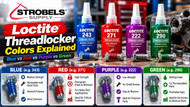
Loctite Threadlocker Colors Explained: Blue vs Red vs Purple vs Green
Oct 19th 2026
Searching for "lock tight"? You're looking for Loctite, the threadlocker brand from Henkel. Loctite threadlockers are color-coded by strength: purple is low, blue is medium, red is high, and green is a wicking grade for parts that are already assembled. Pick the wrong color and you either get a bolt that vibrates loose or one you can't get off without a torch. This guide shows which Loctite to use, how to apply it, and how to remove it.
Loctite Threadlocker Color Chart
| Color | Strength | Common grades | Typical thread size | Removal |
|---|---|---|---|---|
| Purple | Low | 222 | Small screws, up to about 1/4 in. | Hand tools |
| Blue | Medium (removable) | 242, 243, 248 stick | 1/4 in. to 3/4 in. | Hand tools; heat helps if stuck |
| Red | High (permanent) | 262, 263, 268 stick, 271 | Up to 1 in. | Heat the part, then remove while hot |
| Red, high temp | High | 266, 272, 2620 | Up to 3/4 in. (266) to 1-1/2 in. (272) | Heat the part, then remove while hot |
| Green | Wicking | 290 | 1/2 in. and smaller | Heat the part, then remove while hot |
Standard grades are rated to about 300°F (150°C). Most Loctite threadlockers reach full strength in 24 hours at room temperature, and cure more slowly in cold shops.
Blue Loctite: Medium Strength, Removable
Blue is the right choice for most nuts and bolts you may need to service later: machinery covers, brackets, bike and car parts, pumps and motor mounts. It stops vibration loosening but comes apart with normal hand tools.
- Loctite 242 is the classic general-purpose blue.
- Loctite 243 is the upgraded version. It tolerates light oil on the threads and works on stainless and plated fasteners without primer. If you only stock one blue, stock 243.
- Loctite 248 is the same medium strength in a semi-solid stick, so it won't drip on overhead or vertical bolts.
- Loctite 2422 is a blue, medium-strength stick made for higher heat than standard blue.
Red Loctite: High Strength, Permanent
Red is for fasteners you don't plan to take apart: studs, suspension and frame bolts, heavy equipment and anything under constant vibration. Expect to heat the part before it will break loose.
- Loctite 271 is the standard red for bolts up to 1 in.
- Loctite 263 is high strength and more tolerant of oily or plated parts.
- Loctite 262 sits between blue and red: permanent-strength, but easier to remove than 271.
- Loctite 268 is red in stick form, mess-free for overhead work.
High-temperature red: 266, 272 and 2620
Exhaust studs, engine and turbo hardware and parts near heat sources need a high-temp grade. Loctite 266 and Loctite 2620 are fast-curing, oil-tolerant red grades rated to about 450°F (232°C). Loctite 272 covers larger bolts, up to 1-1/2 in.
Purple Loctite: Low Strength
Loctite 222 is for small screws and soft metals such as aluminum and brass: set screws, adjustment screws, electronics and gauges. It keeps them from backing out but won't strip small heads when you remove them.
Green Loctite: Wicking Grade
Loctite 290 is thin enough to wick into threads that are already assembled. Apply it to the joint of a tightened bolt, set screw or electrical connector and it flows into the threads. It also seals porosity in welds and castings.
What About Yellow Loctite?
Yellow Loctite usually means Loctite 577, a thread sealant for metal pipe fittings. It seals against leaks rather than locking a bolt. The same is true of purple Loctite 545, which is made for hydraulic and pneumatic fittings. Don't mix it up with purple 222 threadlocker.
Threadlocker vs. Anti-Seize
They do opposite jobs. A threadlocker keeps a fastener from loosening. Anti-seize keeps it from galling or seizing so it comes apart easily later. Use anti-seize on spark plugs, stainless fasteners and high-heat assemblies you will service. For stainless steel, food and pharma, or nuclear applications, Loctite N-7000 is a metal-free, high-purity anti-seize. Never use threadlocker and anti-seize on the same threads.
How to Apply Loctite Threadlocker
- Clean the threads. Remove oil, grease and old threadlocker with a degreaser and let it dry.
- Prime if needed. Stainless steel, zinc, aluminum and other inactive metals, or a cold shop, cure slowly. A primer such as Loctite 7649 speeds up the cure.
- Apply to the bolt, not the hole. Put a few drops where the nut will engage. For blind holes, put a drop at the bottom of the hole too.
- Assemble and torque to spec.
- Let it cure. Handling strength comes in minutes, but full strength takes about 24 hours.
How to Remove Loctite
Blue and purple come apart with standard hand tools. For red and green, heat the fastener with a heat gun or torch to around 500°F (260°C), then remove it while it's still hot. Clean the cured residue off with a wire brush before you reapply.
FAQ
Is "lock tight" the same as Loctite?
Yes. "Lock tight" is a common spelling of Loctite, the threadlocker brand made by Henkel.
Which Loctite should I use on car bolts?
Use blue 243 for bolts you may service, such as brackets, calipers and covers. Use red 271 or 263 for permanent studs, and a high-temp red (266 or 2620) for exhaust and turbo hardware.
Can I use blue Loctite on plastic?
No. Standard anaerobic threadlockers can crack many plastics. Use them on metal fasteners.
How long does Loctite take to dry?
Most liquid grades fixture in 20 to 30 minutes (sticks in about 5 minutes) and reach full strength in about 24 hours at room temperature.
Shop the full range of Loctite threadlockers, sealants and anti-seize at Strobels Supply, or contact our team if you need help choosing a grade.