
 US Dollars
Sanding Screens for Drywall & Floors Guide
Apr 28th 2026
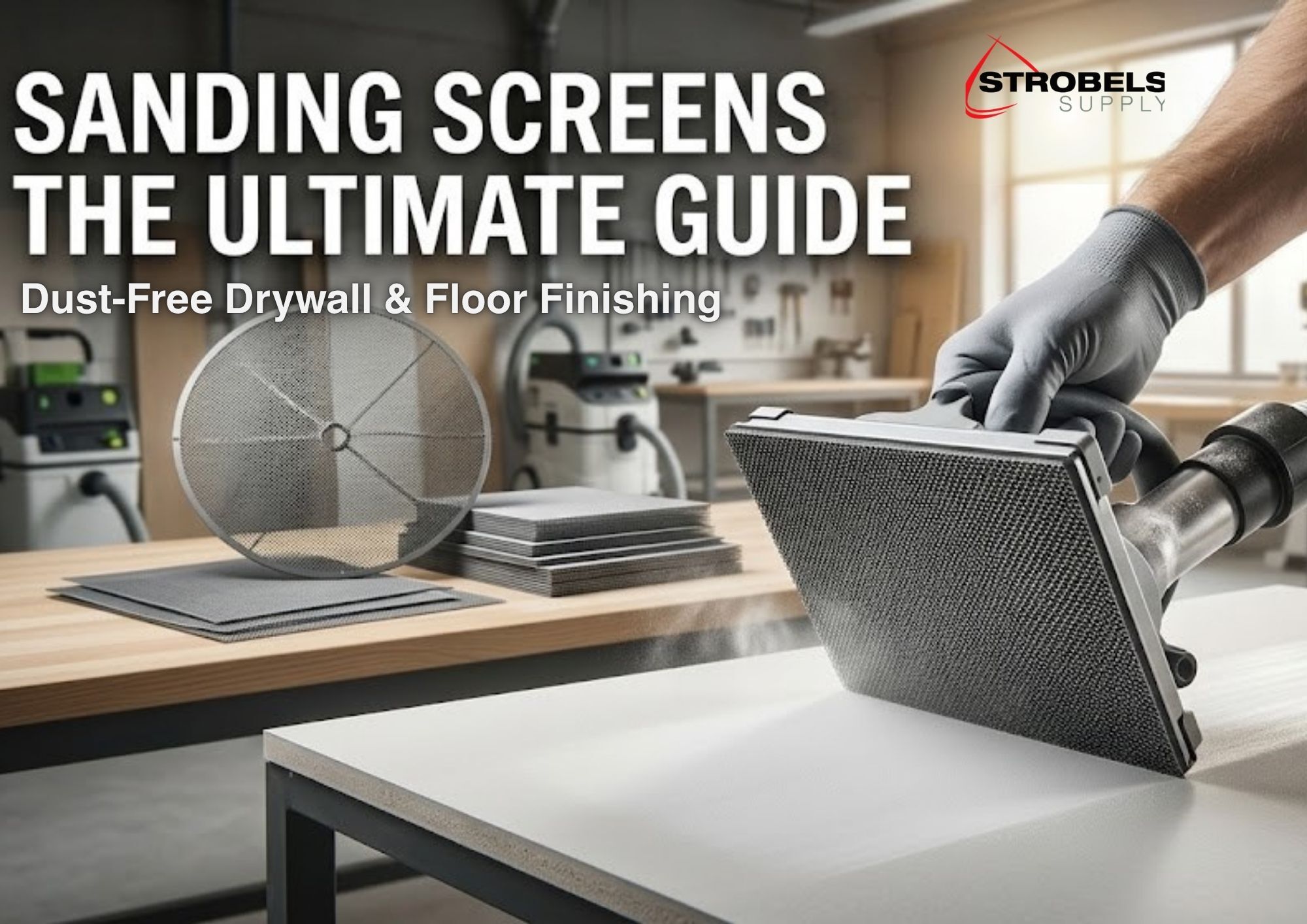
Sanding Screens Guide: Dust-Free Finishing for Drywall & Floors
Table of Contents
- Sanding Screens Basics and Use
- Drywall Sanding Screens
- Floor and Hardwood Sanding Screens
- Wet vs Dry Usage
- Formats, Grits, and Accessories
- Frequently Asked Questions (FAQ)
Sanding Screens Basics and Use
Sanding screens (also called sanding mesh or abrasive screens) are open-weave abrasive tools made from a durable fiberglass or nylon mesh backing coated on both sides with sharp silicon carbide grains. Their defining feature is the porous mesh construction, which allows dust and debris to pass straight through instead of building up on the surface.
How They Differ from Traditional Sandpaper
- Construction: Sandpaper uses a solid paper, cloth, or film backing with abrasive bonded to one side. Sanding screens use a porous mesh for 360° airflow and dust evacuation.
- Dust Management: Screens resist clogging dramatically on soft, powdery materials like drywall compound. Traditional paper loads quickly, reducing cut rate and increasing airborne dust.
- Durability & Reusability: Screens are often double-sided and can be rinsed or banged clean for multiple uses. They last longer in high-dust applications.
- Finish Characteristics: Screens provide a uniform scratch pattern but can leave faint mesh imprints if excessive pressure is used on soft surfaces. Sandpaper offers more precise control for ultra-fine finishes.
Sanding Screen vs Traditional Sandpaper
|
Aspect |
Sanding Screens |
Traditional Sandpaper |
|
Backing |
Open porous mesh (fiberglass/nylon) |
Solid paper, cloth, or film |
|
Dust Control |
Excellent – dust passes through |
Prone to clogging |
|
Durability |
Double-sided, reusable, longer life |
Single-sided, clogs faster |
|
Best For |
Drywall compound, finishes, screening |
Precision work, heavy stock removal |
|
Drawbacks |
Possible faint mesh marks on soft surfaces |
More airborne dust and frequent changes |
Pro Tip: Sanding screens shine wherever dust loading is the biggest frustration — making them a favorite among professional drywallers, painters, and floor refinishers.
Common Uses:
- Drywall joint compound smoothing
- Between-coat sanding on paint, varnish, or polyurethane
- Hardwood floor screening before recoating
- Light surface prep on wood, plaster, or painted surfaces
Drywall Sanding Screens
Drywall sanding screens are the go-to choice for smoothing joint compound, topping mud, and preparing walls/ceilings for primer and paint. The open mesh prevents powdery compound from gumming up the abrasive, delivering consistent cutting with far less dust.
Choosing Drywall Sanding Screens
Grit Selection:
- 100–120 grit: Initial flattening of ridges and high spots after the second or third coat.
- 150–180 grit: Intermediate smoothing and feathering edges.
- 220 grit: Final finish before priming for a smooth, paint-ready surface.
Formats:
- Sheets (pre-cut ~4-3/16" x 11-1/4"): Fit standard hand or pole sanders.
- Pole Sander Screens: Attach to vacuum-assisted pole sanders for ceilings and high walls.
- Sponge-Backed or Hand Pads: For detail work, corners, and edges.
How to Sand Drywall with Screens – Pro Technique
- Setup: Use a vacuum-assisted pole sander or hand sander with dust collection.
- Technique: Apply light, circular or overlapping straight passes with minimal pressure. Let the abrasive do the work.
- Dust Control: Pair with a shop vacuum or HEPA-filtered sander for near dust-free results.
- Finishing: Lightly wipe with a damp sponge or microfiber cloth before priming.
Pro Tip: Many finishers use screens for the bulk of the work and switch to a sanding sponge for tight corners and edges to avoid any mesh imprints.
Floor and Hardwood Sanding Screens
Floor sanding screens are larger-diameter mesh abrasives designed for rotary floor buffers and orbital machines. They excel at light scuffing and de-glossing between coats of finish on hardwood floors.
Floor and Buffer Sanding Screens
- Sizes: 16", 17", 18", 19", and 20" diameters to match standard buffers.
- Grit Progression: 80–100 grit for initial screening if needed, then 120–150 grit for de-glossing, and 180–220 for ultra-smooth finishes.
Screening Hardwood Floors Between Coats
Screen after each coat of polyurethane, varnish, or oil-based finish has dried (usually 24–48 hours). This removes nibs and imperfections without removing significant wood or altering color.
Technique: Attach the screen to a white or maroon non-woven pad on a low-speed buffer (175–300 RPM). Use light, even pressure and keep the machine moving. Back the screen with a soft pad for better conformability and fewer marks.
Wet vs Dry Usage
Many silicon carbide sanding screens support both dry and wet applications. Dry use maximizes their anti-clogging advantage on drywall and finishes. Wet sanding further reduces airborne dust and is useful for specialized projects like stone, tile, or certain finishes.
Note: Not all screens are equally suited for wet use—check manufacturer specs. Wet sanding can produce a smoother satin-like finish on some surfaces but requires proper drying afterward.
Formats, Grits, and Accessories
Available Formats:
- Sheets for hand sanding and pole sanders
- Discs and pads for orbital sanders or floor machines
- Rolls and mesh for custom cutting
Grits and Sizing: Ranges typically from 60 (coarse) to 220 (fine). Most consumer and professional screens follow standard grit sizing (CAMI or equivalent). Some industrial abrasives use P-grade (FEPA) numbering, where the "P" prefix indicates a standardized European particle size distribution—your Strobel’s Supply screens align with common industry grit standards for consistent performance.
Accessories: Vacuum-compatible pole sanders, floor buffer drivers, sanding sponges, and secure holders.
Storage & Maintenance: To maximize reusability, clean screens with a stiff nylon brush, compressed air, or by rinsing under water (for compatible models). Tap or bang out loose dust between uses. Proper cleaning can extend life significantly.
Value-Added Insight: Pairing screens with the right backing pads and vacuum integration maximizes their dust-control advantage and extends tool life.
Frequently Asked Questions (FAQ)
Can you use sanding screens on raw wood?
Possible for light prep, but traditional sandpaper is usually preferred for raw wood. Screens can sometimes leave swirl or mesh marks that are harder to remove on bare wood.
Do sanding screens last longer than sandpaper?
Yes. Because they are double-sided, resist clogging, and can be cleaned, a single screen often outlasts 3–5 sheets of standard sandpaper in dusty applications.
Can you use sanding screens wet?
Many silicon carbide screens can be used damp or wet to reduce dust further, especially on certain finishes or tile projects. Always confirm compatibility with the specific product.
What’s the difference between P-grade and standard grit?
Standard grit (often CAMI) and P-grade (FEPA) are parallel systems for measuring abrasive particle size. They perform similarly in the common ranges used for drywall and floors (up to ~220).
Find the Right Sanding Screens for Your Project
Looking for high-quality sanding screens, drywall mesh, floor sanding screens, pole sanders, and compatible accessories from trusted brands?
Strobel’s Supply offers a dedicated selection of sanding screens alongside the full range of coated abrasives perfect for professional drywall finishing, hardwood floor refinishing, and precision between-coat sanding.
Browse the complete Sanding Screens collection today.
Or explore the full abrasives section.
Need help selecting the right grit, format, or vacuum-compatible setup? Contact the abrasives experts at Strobel’s Supply.
This guide is for educational purposes. Always follow manufacturer instructions, use proper PPE (dust mask/respirator), and ensure adequate ventilation when sanding.