
 US Dollars
Abrasive Cones: Types, Grits & Application Guide
Apr 28th 2026
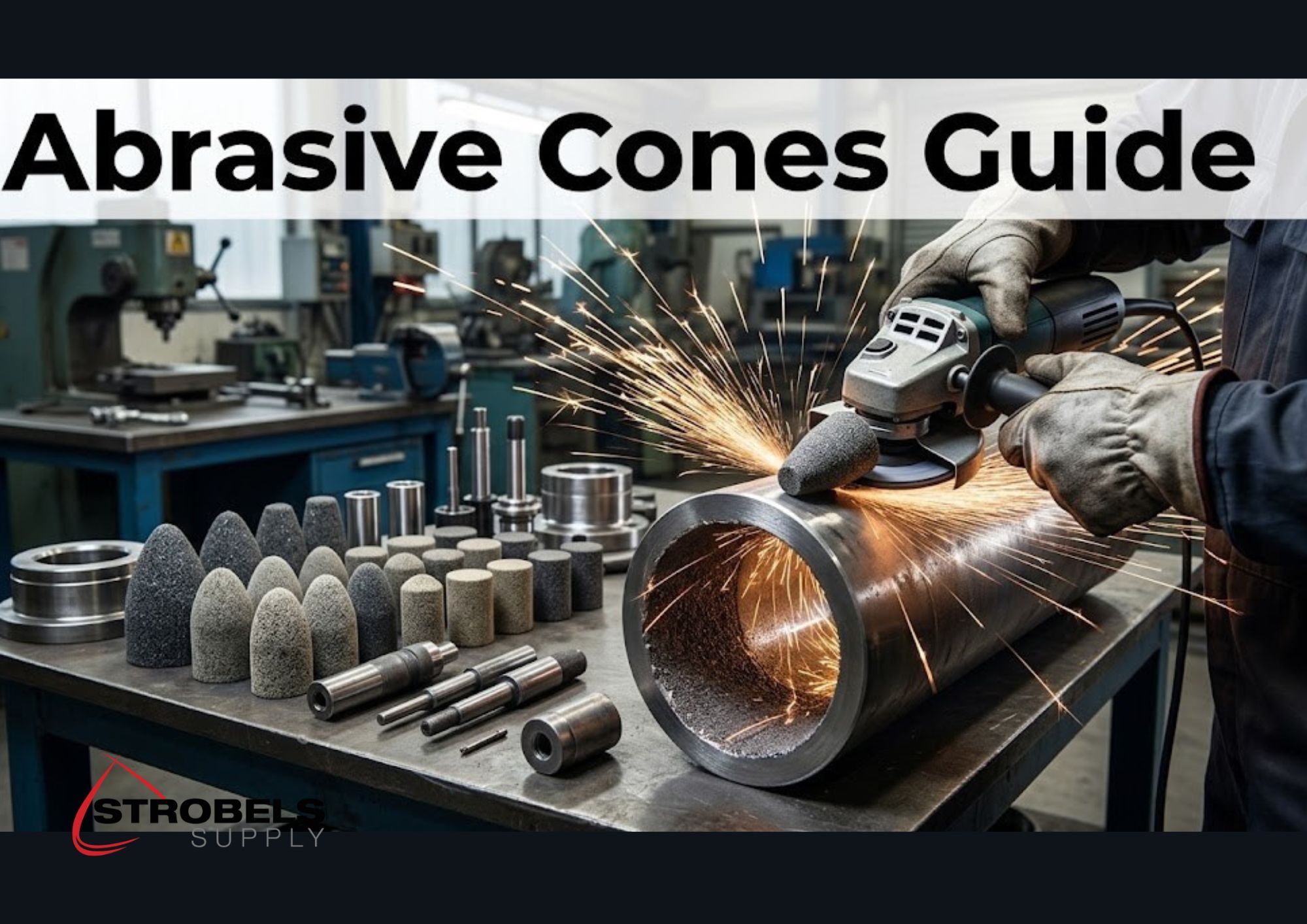
The Industrial Professional's Complete Guide to Abrasive Cones
By the Technical Team at Strobels Supply | Updated 2025
Table of Contents
Click any section below to jump directly to that part of the guide.
- What Is an Abrasive Cone?
- Types of Abrasive Cones (ANSI Shapes)
- Abrasive Materials & Grain Selection
- Grit Selection Guide
- Tools, RPM & Compatibility
- Safety & OSHA Compliance
- Common Problems & Troubleshooting
- Brand Comparison & Buying Guide
- Quick Selection Guide
- Frequently Asked Questions (FAQ)
If you've ever tried to clean a weld seam inside a 2-inch pipe with a flat grinding disc, you already know why abrasive cones exist. You can't get there. The disc won't fit, the angle is wrong, and you end up with either an untouched weld or a gouged pipe wall. Cones solve exactly this problem — and when you spec the wrong one, you'll spend more time grinding, burn through tooling faster, and potentially create a safety hazard in the process.
At Strobels Supply, we field calls and emails about abrasive cone selection every week. The same questions come up repeatedly: What's the difference between a Type 16 and Type 17? Can I use aluminum oxide on stainless? Why is my cone glazing? This guide answers all of them, drawn from years of helping fabricators, foundries, and maintenance crews get their cone selection right the first time.
What Is an Abrasive Cone — And When Do You Actually Need One?
An abrasive cone is a bonded abrasive tool: abrasive grain (aluminum oxide, zirconia, silicon carbide, or ceramic) mixed with a resin bond, formed into a conical shape, and mounted on a threaded steel arbor. That threaded arbor screws directly onto an angle grinder or die grinder spindle. The cone then grinds on contact removing metal, weld material, casting flash, or burrs from surfaces a flat wheel simply cannot reach.
The keyword here is bonded. Unlike a flap disc or sandpaper, where grains are coated onto a flexible backing, a bonded abrasive cone has grains distributed throughout a rigid body. That makes it significantly more aggressive higher stock removal rates, capable of true snagging work but it also means it must be handled, inspected, and operated with the same rigor as a grinding wheel. The same ANSI B7.1 standard that covers bench grinder wheels covers abrasive cones.
Use an abrasive cone when:
- You need to grind the interior of pipe, tubing, or a casting bore
- You're cleaning parting lines, gates, or risers off sand castings
- You need to reach a tight-radius joint, inside corner, or contoured surface
- You're deburring the exit side of a drilled hole or a large countersink
Use something else when:
- You're blending a flat or exterior weld seam (use a flap disc or grinding wheel)
- You're finishing to a specific surface Ra in a small bore under 1" diameter (use cartridge rolls or mounted points)
- You're doing light surface conditioning (use a non-woven product)
The Four ANSI Cone Types: Which Shape Do You Need?
Abrasive cones are classified by ANSI shape number. Understanding the geometry tells you where each one works — and where it doesn't.
Type 16 — Curved Cone (The Workhorse)
The Type 16 has curved sides and a rounded apex. That convex profile creates broad contact with the workpiece, which is exactly what you want for snagging: maximum material removal, distributed cutting force, and lower risk of gouging. This is the most common shape on industrial floors for a reason. If you're grinding weld beads inside pipe joints, cleaning casting parting lines, or removing flash on structural steel, start with a Type 16.
Type 17 — Straight-Taper Cone (Precision Access)
The Type 17 has straight, flat tapered sides that converge to a defined point. Where the Type 16 makes broad contact, the Type 17 makes precise contact — at the tip. That pointed geometry lets it enter tight-radius contours, sharp inside corners, and narrow V-groove weld preparations where the Type 16 profile won't fit. If geometry is your constraint, the Type 17 is your solution.
Type 18 / 18R — Plugs (Cylindrical Body)
Technically plugs rather than cones, these cylindrical bonded abrasive bodies round out the family. The Type 18 has a flat end for grinding flat-bottomed pockets and internal flat surfaces. The Type 18R has a rounded end for curved internal surfaces — inside pipe elbows, casting radii, curved flanges.
Type 19 — Hybrid Cone-Plug
The Type 19 combines a cylindrical body with a conical tip, letting you grind both flat and tapered sections of a countersink or chamfer in a single setup. Niche application, but useful when you encounter it.
Grain Selection: Match the Abrasive to the Material
This is where most spec errors happen. The wrong grain on the wrong material costs you cut rate, cone life, surface quality, and sometimes the workpiece itself.
Brown Aluminum Oxide — The Standard for Ferrous Work
Brown aluminum oxide (Al₂O₃) is the correct baseline choice for carbon steel, alloy steel, ferrous castings, and forged steel. It's durable, widely available, and cost-effective for general snagging and weld cleanup. It is not the right choice for stainless steel (more on that below) or non-ferrous metals.
Zirconia Alumina — Step Up for High-Volume Steel Work
Zirconia alumina (typically 25% ZrO₂, 75% Al₂O₃) micro-fractures under grinding pressure at the sub-micron level, continuously exposing fresh sharp cutting edges. The practical result: higher removal rate, lower grinding temperature, and substantially longer life than regular aluminum oxide on the same ferrous application. In our experience helping fabrication shops run TCO comparisons, customers switching from brown aluminum oxide to zirconia alumina on carbon steel snagging consistently see 1.5–2.5x longer cone life per unit. When you factor in the 3–5 minutes of downtime per cone change, the economics shift decisively toward zirconia even at a higher unit price.
Key products: Weiler Tiger Zirc, SAIT Z-Tech, Norton BlueFire.
Silicon Carbide — Non-Ferrous and Cast Iron
Silicon carbide (SiC) is harder and sharper than aluminum oxide, but more brittle. It's the right choice for: aluminum, bronze, copper, gray and ductile cast iron, stone, and ceramics. The important rule: never use silicon carbide on steel. Chemical reactions at grinding temperatures cause rapid grain wear and heavy loading. And conversely, never use aluminum oxide on aluminum the soft metal bonds to the grain and clogs it, generating heat that smears the workpiece surface.
Ceramic Aluminum Oxide — Maximum Performance on Hard Alloys
Produced through a sol-gel sintering process that creates a microcrystalline structure, ceramic alumina delivers the highest removal rate and longest life of any conventional abrasive. It's the right specification for stainless steel pipe welds, HRSA alloys, and hard alloy steels in production environments. Higher unit cost, but consistently the most economical choice cost-per-part when you're running volume.
| Grain | Best For | Cut Rate | Life | Cost Tier |
|---|---|---|---|---|
| Brown Aluminum Oxide | Carbon steel, ferrous castings | Good | Moderate | $ |
| Zirconia Alumina | Carbon steel, high-volume steel snagging | Excellent | High | $$ |
| Silicon Carbide | Cast iron, aluminum, bronze, stone | Good | Moderate | $ |
| Ceramic Aluminum Oxide | Stainless steel, HRSA, hard alloys | Superior | Very High | $$$ |
Grit: How Coarse Do You Actually Need to Go?
For most industrial cone applications, the answer is coarser than you think.
- 16–24 grit — Maximum removal. Foundry snagging, casting gates and risers, heavy weld bead removal. Very rough surface output; plan for secondary work.
- 24–36 grit — The production standard for weld cleanup and pipe grinding. Best balance of removal rate and usable surface condition.
- 46–60 grit — Moderate removal with a cleaner surface. Use when downstream inspection requires less prep, or when you're deburring and chamfering rather than snagging.
- 80–120 grit — Light stock removal. Edge radiusing, contour blending, pre-inspection cleanup on precision work.
If a weld must pass dye penetrant (PT) or radiographic inspection after grinding, move to 36–60 grit. The cleaner surface is significantly easier to inspect reliably.
Tools and RPM: The Non-Negotiable Safety Check
Every abrasive cone carries a maximum rated RPM stamped on the body or its packaging. Your grinder's no-load RPM appears on the nameplate or in the manual. The grinder's no-load RPM must be at or below the cone's rated maximum RPM. This is a hard safety requirement under ANSI B7.1, not a suggestion.
A few practical reference points:
- Standard 4.5" angle grinder at 11,000–12,000 RPM no-load is safely within the 18,100 RPM rating of a standard 2"–3" industrial cone.
- Die grinders and pneumatic straight grinders run at 20,000–35,000 RPM. Only small-format cone points on 1/4" shanks rated for those speeds belong in these tools. Die grinder overspeed is the most common cause of cone point failure — and at 25,000+ RPM, a fragmenting cone point is a serious projectile hazard.
- Hand drills (1,500–2,800 RPM) run far too slow for efficient cone grinding. Cones glaze rather than cut at those speeds. Light chamfering and deburring in soft materials is the only reasonable application.
Also verify arbor thread: the two standard specifications in U.S. industrial practice are 5/8-11 UNC (most common on 4.5"–7" angle grinders for large industrial cones) and 3/8-24 UNF (smaller portable grinders). A 5/8-11 cone cannot run on a 3/8-24 grinder without an adapter.
Safety: What You're Required to Know
Abrasive cones fall under OSHA 1910.215 (Abrasive Wheel Machinery) and OSHA 1910.243(b) (Portable Powered Tools). These are not optional guidelines — violations are citable.
Before You Mount a Cone
Visually inspect the body for cracks, chips, or damage before every use. For vitrified cones, perform the ring test: tap lightly with a non-metallic object. A clear ringing tone means intact. A dull thud means internal cracking — discard immediately. Resinoid bond cones (the most common type for portable grinding) don't ring; rely on visual inspection.
Never mount a cone that has been dropped onto a hard surface, regardless of how it looks.
PPE — The Minimum Standard
| Hazard | Required Protection |
|---|---|
| Flying particles and sparks | ANSI Z87.1 safety glasses + full face shield |
| Dust inhalation | N95 minimum; P100 for stainless/chromium alloy grinding |
| Noise (90–100 dB) | Hearing protection NRR 25+ |
| Hand/wrist injury | Cut-resistant gloves ANSI A4+ |
Keep the wheel guard in place. Removing the angle grinder guard is an OSHA 1910.243 violation, full stop.
The Stainless Steel Warning
If you grind stainless steel, chromium alloys, or chromate-coated materials, OSHA 1910.1026 applies independently. Grinding stainless generates hexavalent chromium (Cr VI) particulate — a confirmed human carcinogen with an OSHA PEL of 5 micrograms per cubic meter (8-hour TWA). Engineering controls (local exhaust ventilation) are required before relying on respiratory PPE. A P100 half-face respirator is required when LEV is not feasible. Separate clothing laundering, hand washing before eating, and no eating or drinking in grinding areas are compliance requirements, not suggestions.
Common Problems and What They Mean
Cone is glazing and not cutting. The bond isn't releasing worn grains fast enough to expose fresh cutting edges. Common causes: material is too soft for the grain (aluminum with aluminum oxide); insufficient grinding pressure; bond grade too hard for the application; RPM too high. Solutions: increase pressure slightly, switch to a more friable grain, or select a softer bond grade.
Cone is wearing very fast. The opposite problem — usually a bond grade too soft, too much pressure, or the wrong grain for the material hardness. Also check that you're not running an RPM significantly below the cone's efficient operating range.
Cone broke during use. Four primary causes: overspeed; lateral bending force applied to the cone body; incorrect mounting creating eccentric loading; or an internally cracked cone run without proper inspection. Any fragmentation event should trigger an immediate review of your inspection and RPM verification procedure.
How to Compare Brands on Value, Not Just Price
Unit price does not tell you what a cone costs. The right metric is cost per pound of material removed. A simple five-step evaluation:
- Define a fixed test condition: same material, same tool, same operator, timed grind (10 minutes works well).
- Weigh the cone before and after. Record workpiece material removed.
- Calculate removal ratio: pounds removed per dollar of cone cost.
- Factor in changeover time: each cone change takes 3–5 minutes. A cone lasting twice as long at 1.8x the price is the more economical choice when downtime is included.
- Check surface condition: a cone leaving excessive heat blueing or deep scoring may add finishing steps that cost more than the tooling savings.
The brands our team reaches for most frequently in industrial applications — Weiler Tiger/Tiger Zirc, United Abrasives/SAIT, and Norton — consistently hold up well in these comparisons, particularly in the zirconia and ceramic tiers for production work.
Quick Selection Reference
| Step | Key Question | Answer |
|---|---|---|
| Material | Carbon steel, stainless, cast iron, aluminum? | Al₂O₃ for ferrous; SiC for non-ferrous; Zirconia/Ceramic for stainless and HRSA |
| Geometry | Inside pipe? Casting contour? Drilled hole? | Type 16 (wide contact); Type 17 (tight radius); Plug (flat/cylindrical ID) |
| Outcome | Max snagging or finish to spec? | 16–24 snagging; 36–60 general cleanup; 80–120 deburring/blending |
| Tool | Grinder RPM and arbor thread? | Cone RPM rating must exceed grinder no-load RPM; verify 5/8-11 or 3/8-24 thread |
| Volume | One-off MRO or production? | Zirconia/Ceramic for production TCO; Aluminum oxide for MRO and low volume |
Get the Right Cone for Your Application
Choosing the right abrasive cone improves performance, tool life, and efficiency. If you're working on a new application or facing issues with current tools, our team can help you specify the right solution.
Browse our range at strobelssupply.com, featuring 3M, Pferd, SAIT, Mirka, and more. Volume pricing and supply programs are available for production operations.
Frequently Asked Questions (FAQ)
What are abrasive cones used for?
Abrasive cones are used for grinding, deburring, and removing material in tight or hard-to-reach areas such as pipes, internal bores, and contoured surfaces.
What is the difference between Type 16 and Type 17 abrasive cones?
Type 16 cones have a curved shape for aggressive material removal and snagging, while Type 17 cones are straight-tapered and better suited for precision work in confined spaces.
Which abrasive material should I use for stainless steel?
Ceramic aluminum oxide or zirconia alumina are the best choices for stainless steel due to their durability, cutting efficiency, and resistance to heat buildup.
What grit should I use for grinding and finishing?
Coarse grits (16–36) are used for heavy stock removal, medium grits (46–60) for general grinding, and fine grits (80–120) for deburring and finishing.
Can abrasive cones be used on a die grinder?
Yes, abrasive cones can be used on die grinders and angle grinders, but you must ensure the correct arbor size and operate within the recommended RPM limits.
Why is my abrasive cone glazing or not cutting properly?
Glazing occurs when the abrasive surface becomes smooth due to heat or incorrect material selection. Using a more aggressive grit or switching to a different abrasive material can solve this issue.
Are abrasive cones safe to use?
Yes, but only when used properly. Always inspect the tool before use, follow RPM ratings, and wear appropriate PPE such as eye protection and gloves.
When should I replace an abrasive cone?
Replace the cone when it shows excessive wear, reduced cutting performance, visible damage, or imbalance during operation.