
 US Dollars
Abrasive Discs: Types, Grits & Tool Compatibility
Apr 1st 2026
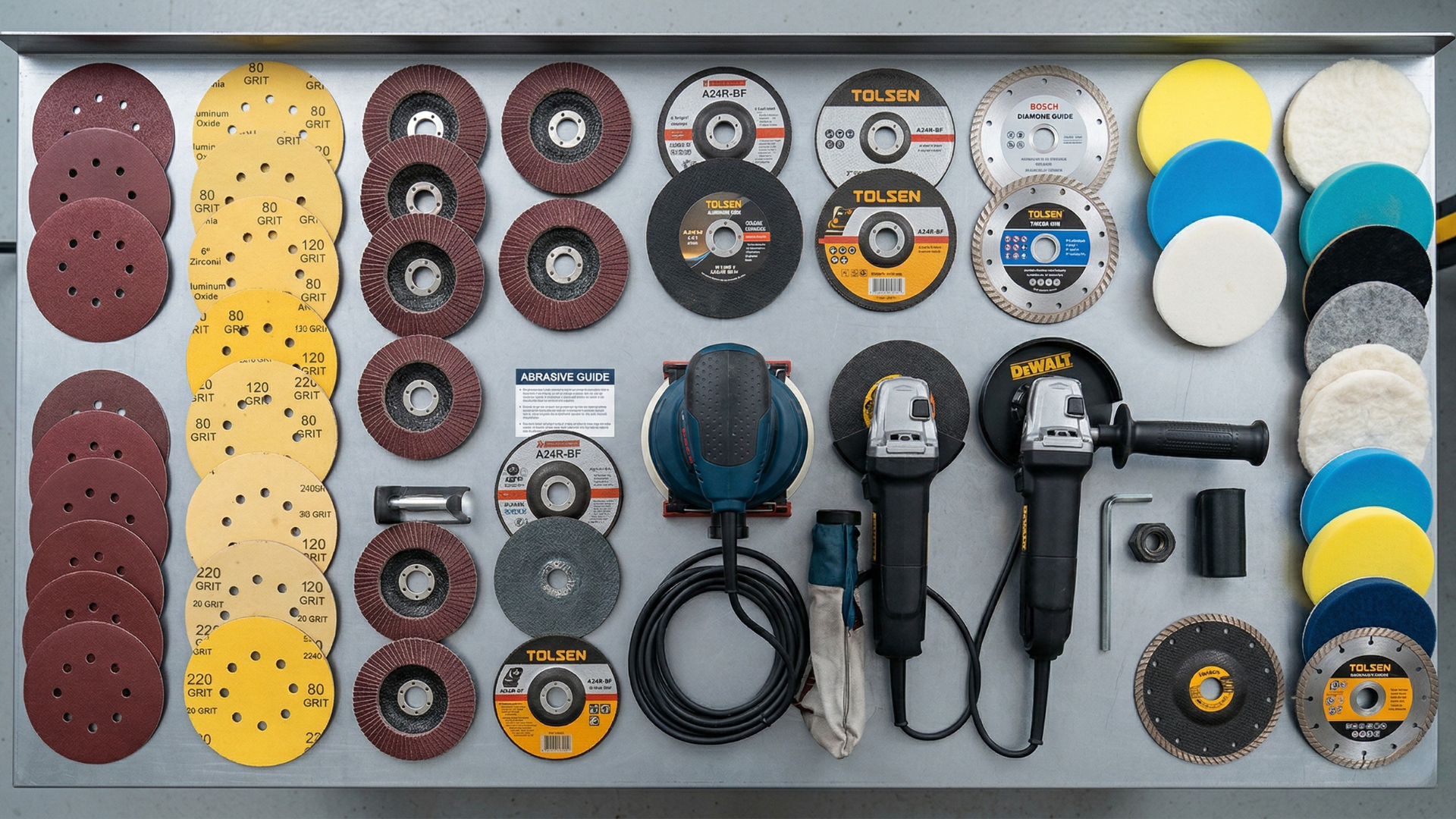
THE COMPLETE GUIDE TO Abrasive Discs
Introduction to Abrasive Discs
Whether you're a seasoned metalworker, a woodworking enthusiast, or a DIY hobbyist who's just picking up an angle grinder for the first time, understanding abrasive discs is fundamental to getting great results — safely and efficiently. This guide covers everything: definitions, types, materials, grit sizes, tool compatibility, specialized applications, care, and the brands professionals trust most.
Choosing the right abrasive disc doesn't just improve your results — it saves time, reduces tool wear, and keeps you safer on the job.
What Are Abrasive Discs?
An abrasive disc is a circular cutting, grinding, or sanding tool made by bonding abrasive grains to a backing material such as paper, fiber, cloth, or resin. These discs are designed to attach to power tools like angle grinders, orbital sanders, drills, or die grinders, and they work by using the sharp edges of their abrasive grains to remove material through friction.
Abrasive discs come in a staggering variety of sizes, grit ratings, abrasive types, and constructions. Each variant is engineered for a specific combination of material, tool, and application whether that's stripping rust from steel, smoothing a hardwood floor, cutting through concrete, or achieving a mirror polish on aluminum.
What Are Abrasive Discs Used For?
Abrasive discs serve a wide range of tasks across industries including manufacturing, construction, automotive repair, metal fabrication, woodworking, and dentistry:
- Grinding and removing excess material from welds, castings, or rough surfaces
- Cutting metal, stone, concrete, tile, and other hard materials
- Sanding and smoothing wood, drywall, fiberglass, and composites
- Polishing metal, plastic, and painted surfaces to a fine finish
- Surface preparation before painting, coating, or bonding
- Deburring and edge finishing on fabricated parts
- Dental applications — shaping, polishing, and adjusting restorations
What Are Abrasive Discs Made Of?
The performance of an abrasive disc depends heavily on what it's made of. There are two main components: the abrasive grain and the backing/bond system.
Abrasive Grains
The grain is the cutting element the sharp particles that do the actual work:
- Aluminum Oxide (Alumina) — The most widely used general-purpose abrasive. Hard, tough, and economical. Works well on steel, wood, and most metals.
- Zirconia Alumina — Tougher and more durable than standard aluminum oxide. Ideal for aggressive stock removal on stainless steel, cast iron, and hardened alloys.
- Silicon Carbide — Extremely hard and sharp, but more brittle. Best for hard, non-metallic materials like stone, glass, ceramics, and non-ferrous metals.
- Ceramic Alumina — The premium grain type. Self-sharpening microcrystalline structure means longer life and cooler cutting. Excellent for hard metals and high-pressure applications.
- Diamond — The hardest known material. Used in cutting discs for concrete, ceramics, and tile, as well as polishing discs for precision applications and dentistry.
- Garnet — A natural abrasive used mainly in woodworking. Softer and less aggressive than synthetic abrasives.
Backing and Bond Materials
The backing holds the abrasive grain and determines flexibility and application suitability:
- Resin Fiber Backing — Used in grinding and heavy-duty sanding discs. Rigid and durable.
- Cloth Backing — Flexible and tear-resistant. Used in flap discs and sanding belts.
- Paper Backing — Common for orbital and sheet sanding. Comes in light (A/C weight) to heavy (D/E weight).
- Non-Woven Nylon — Used in surface conditioning and cleaning discs for light finishing and polishing.
- Steel/Aluminum Core — Found in diamond discs for rigid support.
Are Abrasives Ceramic?
Not all abrasives are ceramic, but ceramic alumina is one of the most advanced abrasive materials available. Traditional abrasives like aluminum oxide and silicon carbide are also technically ceramic compounds (hard, inorganic, non-metallic materials). However, when manufacturers label a product as 'ceramic,' they typically mean it uses next-generation sol-gel ceramic alumina grain — engineered at the microscopic level for controlled, continuous self-sharpening. This makes ceramic abrasive discs last significantly longer and cut cooler than conventional alternatives, justifying their higher price point for demanding applications.
Types of Abrasive Discs
Not all abrasive discs are created equal. The disc type you choose dictates the tool you use, the material you can work on, and the finish you'll achieve. Here's a comprehensive breakdown:
Sanding Discs
Sanding discs are coated abrasive discs designed primarily for surface preparation, smoothing, and finishing. They attach to orbital sanders, random orbital sanders, or backing pads on grinders, and come in paper, cloth, or film backing. Sanding discs range from coarse grits (40–60) for aggressive material removal to ultra-fine grits (320–1000+) for finishing and polishing. Hook-and-loop (Velcro) and PSA (pressure-sensitive adhesive) are the two most common attachment methods.
Grinding Discs
Grinding discs are heavy-duty resin-bonded discs used for aggressive stock removal, weld blending, and surface conditioning on metal. They're typically made with aluminum oxide or zirconia alumina on a thick fiberglass-reinforced resin fiber backing. Unlike sanding discs, grinding discs are used at higher speeds on angle grinders and generate significant heat and sparks. They're available in depressed-center (Type 27) or flat (Type 1/Type 41) profiles.
Sanding Disc vs. Grinding Disc — Key Differences
|
Feature |
Sanding Disc |
Grinding Disc |
|
Primary Use |
Smoothing & finishing |
Stock removal & weld blend |
|
Typical Speed |
Lower (4,000–12,000 RPM) |
High (10,000–13,300 RPM) |
|
Backing |
Paper, film, cloth |
Thick resin fiber |
|
Tool |
Orbital/random orbital sander |
Angle grinder |
|
Finish |
Smooth to mirror-like |
Rough to moderate |
What Is a Grinding Disc?
A grinding disc (also called a grinding wheel or grinding pad) is a bonded abrasive product used with an angle grinder or bench grinder to remove material, clean surfaces, or shape workpieces. The disc is held together with a resin bond that releases worn abrasive grains to expose fresh sharp ones — a self-sharpening mechanism. Grinding discs are rated with a maximum RPM that must never be exceeded, as over-speeding can cause catastrophic disc failure.
Cutting Discs
Cutting discs (cut-off wheels) are thin, reinforced discs designed to cut through metal, stainless steel, stone, or masonry. Their narrow profile (typically 1–3mm thick) allows for clean, precise cuts with minimal material loss. They should never be used for grinding — side loading a cutting disc can cause it to shatter. Standard cutting discs are Type 1 (flat) and Type 41, while depressed-center versions (Type 42) provide better clearance.
⚠️ Safety Note: Always use a cutting disc only for cutting, never for side-grinding. The thin profile cannot handle lateral forces.
Flap Discs
Flap discs are one of the most popular disc types in metal fabrication. They consist of multiple overlapping 'flaps' of coated abrasive cloth arranged radially around a central hub. As the outer layers wear, fresh abrasive is continually exposed — making flap discs highly efficient and long-lasting. They're ideal for blending welds, contouring, and finishing in one step. Flap discs come in Type 27 (flat) and Type 29 (angled/conical) profiles, with the angled version providing more aggressive stock removal and better surface contact on flat workpieces.
Abrasive Mesh Discs
Mesh discs feature an open-weave structure rather than a solid backing. The mesh design dramatically reduces dust loading — the abrasive stays clear and effective much longer than paper-backed discs. They're excellent for sanding paint, filler, and primer on automotive bodywork, drywall, and composite materials. The open structure also provides better airflow for dust extraction systems.
Non-Woven Abrasive Discs
Non-woven abrasive discs use a three-dimensional nylon fiber web impregnated with abrasive grain. Rather than cutting aggressively, they condition surfaces — cleaning rust, scale, and oxidation without significantly altering the base material's dimensions. They're used for surface prep, light deburring, blending scratches, and achieving consistent matte or satin finishes. Common brand names include Scotch-Brite (3M) and Bear-Tex. They won't load up with metal particles like conventional abrasive discs.
Diamond Discs
Diamond discs use industrial diamonds (natural or synthetic) bonded to a steel core. Because diamonds are the hardest material on earth, these discs can cut and grind materials that would rapidly destroy conventional abrasives — including concrete, granite, porcelain tile, ceramics, glass, and hardened tool steels. Diamond discs come in continuous rim (for smooth cuts), segmented rim (for faster cutting with better cooling), and turbo rim (a balance of both). They're also used in dental labs for precision work on restorations.
Coated vs. Non-Woven Abrasives
Coated abrasives have grains bonded to a flat backing in either open-coat (spaced grains for reduced loading) or closed-coat (dense grains for more aggressive cutting) patterns. Non-woven abrasives, as described above, use a 3D fiber matrix. Coated discs excel at material removal and defined surface finishes; non-woven discs excel at surface conditioning, cleaning, and producing consistent fine finishes without removing much metal.
Abrasive Discs for Specific Materials
One of the most critical selection factors is matching your disc to your workpiece material. Using the wrong abrasive on a material can result in poor cutting performance, heat damage, contamination, or even dangerous conditions.
Abrasive Discs for Metal
For general steel and iron applications, aluminum oxide and zirconia alumina grinding and flap discs are the industry standard. Zirconia discs provide significantly longer life on hard metals due to their self-sharpening fracture pattern. For cutting, standard aluminum oxide or A/WA cut-off wheels work well. A grit range of 36–80 is typical for grinding and blending; 80–120 for finishing metal surfaces.
? Pro Tip: On carbon steel, zirconia flap discs at 40–60 grit give you aggressive stock removal plus a decent finish in one pass — eliminating a separate grinding step.
Abrasive Discs for Stainless Steel
Stainless steel demands special attention. You must use abrasives specifically labeled 'for stainless steel' — these are formulated to be iron-free and sulfur-free to prevent corrosion and contamination of the passive layer. Zirconia alumina and ceramic alumina discs are the preferred choices. They cut cooler (critical for stainless, which can discolor with heat), last longer, and won't embed iron particles that cause rust spots. For finishing stainless to a bright or brushed look, progress through grits 60 → 120 → 180 or finer.
⚠️ Safety Note: Never use the same disc on carbon steel and stainless steel. Cross-contamination will cause rust in the stainless surface.
Abrasive Discs for Aluminum
Aluminum is soft and can quickly clog conventional abrasives. Choose open-coat aluminum oxide or silicon carbide discs with an anti-loading ('stearate') treatment. Flap discs and sanding discs with stearate coating dramatically resist aluminum buildup. For grinding, use aluminum-specific grinding discs — standard steel discs can cause the aluminum to load up and create a smeared, ineffective surface. A medium grit (80–120) is effective for most aluminum finishing work.
Abrasive Discs for Wood
Woodworking abrasives are typically garnet, aluminum oxide, or silicon carbide on paper or cloth backing. For orbital sanders, hook-and-loop or PSA paper-backed discs are standard. Start with 60–80 grit for rough shaping and material removal, progress to 120–180 for surface preparation, and finish with 220–320 grit before applying finishes. For hardwoods, silicon carbide discs provide excellent results. Mesh abrasive discs are very popular for sanding primer and paint on wood due to their anti-clogging properties.
Abrasive Discs for Concrete
Concrete, masonry, and stone require diamond or silicon carbide abrasives. Diamond grinding discs and diamond cup wheels are used with angle grinders for removing coatings, leveling surfaces, and preparing concrete for epoxy or other treatments. For cutting concrete, diamond cut-off wheels — particularly segmented or turbo rim designs — provide the best performance. Never use standard metal grinding discs on concrete; they'll wear rapidly and may create unsafe conditions.
Abrasive Discs for Various Tools
Matching the disc to the correct tool is just as important as matching it to the material. Using a disc on the wrong tool can cause dangerous disc failure or poor results.
Abrasive Discs for Angle Grinders
The angle grinder is the most versatile tool in the abrasive disc world. It can accept grinding discs, cutting discs, flap discs, wire wheels, diamond cups, and surface conditioning discs — all via a standard 5/8–11 arbor. Disc diameters of 4.5", 5", and 7" are most common. Always ensure your disc's maximum RPM rating exceeds your grinder's no-load speed, and use the appropriate guard for the disc type being used.
⚠️ Safety Note: Always use a guard. Replace it — never remove it — for cutting or grinding tasks. A bursting disc without a guard can cause fatal injuries.
Abrasive Discs for Bench and Right-Angle Grinders
Bench grinders typically use bonded abrasive wheels rather than discs, but resin fiber discs can be used with appropriate backing pads. Right-angle grinders (a variant of angle grinders) use the same disc types. Heavy-duty right-angle grinders are commonly found in fabrication shops running 7" or 9" grinding and flap discs for high-volume material removal.
Abrasive Discs for Drills
Drills can accept smaller sanding discs — typically 2" to 3" — using a rubber backing pad with a mandrel. These are ideal for sanding in tight areas, finishing curved surfaces, or working on automotive bodywork. They operate at lower speeds than grinders, so choose discs rated for drill speeds. Flap wheels and drum sanding attachments for drills are also available for contour sanding.
Abrasive Discs for Die Grinders
Die grinders are high-speed, compact tools used for precision grinding, deburring, porting, and finishing in tight spaces. They use smaller discs (1" to 3"), typically mounted on mandrels. Common disc types include mounted flap wheels, rubber-bonded abrasive discs, and surface conditioning discs. Die grinders run at very high RPM (up to 30,000 RPM), so always verify your disc's maximum speed rating before use.
Abrasive Discs for Orbital Sanders
Orbital and random orbital sanders are the workhorse tools for woodworking, body repair, and finishing applications. Standard disc sizes are 5" (most common), 6", and occasionally 8". Hook-and-loop (hook-and-loop) backing is the most popular for easy disc changes; PSA (stick-on) discs are more economical but harder to change mid-project. Random orbital sanders produce a swirl-free finish by combining rotation and oscillation. Use quality sanding discs to avoid premature wear and uneven cutting.
Different Grit Sizes and Materials
Grit size is one of the most important specifications of any abrasive disc. It determines how aggressively the disc cuts and what surface finish it leaves behind.
Understanding Grit Sizes
Grit refers to the number of abrasive particles per square inch — the higher the number, the finer the abrasive and the smoother the finish:
|
Grit Range |
Classification |
Typical Applications |
|
16–36 |
Extra Coarse |
Heavy grinding, weld removal, rust removal |
|
40–60 |
Coarse |
Aggressive sanding, paint stripping, shaping |
|
80–120 |
Medium |
General sanding, surface prep, weld blending |
|
150–180 |
Fine |
Finish sanding, scratch removal |
|
220–320 |
Very Fine |
Final sanding before finishing/coating |
|
400+ |
Ultra Fine |
Polishing, between-coat sanding |
Coarse Abrasive Discs
Coarse discs (40–60 grit) are your go-to for the heavy work: removing large amounts of material quickly, cleaning up badly pitted or rusted surfaces, shaping wood, or removing old coatings. They leave a rough surface texture that will need to be refined with finer grits in subsequent passes. Always start with the coarsest grit necessary — going finer than needed from the start is inefficient.
Zirconia Abrasive Flap Discs
Zirconia alumina flap discs are arguably the most productive discs for metal fabrication work. The zirconia grain features a controlled fracture pattern — as it wears, it self-sharpens by fracturing along cleavage planes to expose new cutting edges. This means consistent cutting action throughout the disc's life, reduced heat buildup, and longer disc life compared to aluminum oxide flap discs. Zirconia flap discs are available in 36–120 grit and are ideal for stainless steel, hard steel alloys, and cast iron.
Aluminum Oxide Abrasive Discs
Aluminum oxide (alumina) is the most common abrasive material for a reason — it offers a very good balance of hardness, toughness, and cost. Brown fused alumina is the standard type used in grinding discs and general-purpose sanding discs. White aluminum oxide is purer and used for precision grinding of tool steels and where heat sensitivity is an issue. Pink aluminum oxide offers intermediate properties. For everyday applications on mild steel, wood, and general materials, aluminum oxide discs deliver excellent value.
Abrasive Disc Dimensions
Selecting the correct disc size is essential for compatibility with your tool, safety, and job efficiency.
2-Inch Abrasive Discs
2" discs are small specialty discs used with die grinders, drills, or mandrel-mounted tools. They excel in tight spaces, detailed work, and porting applications. Common in automotive finishing, aerospace manufacturing, and dental applications. PSA or quick-change (roloc/snap-on) mounting is typical.
5-Inch Abrasive Discs
5" discs are the most popular size for random orbital sanders and small angle grinders. They're the standard in automotive bodywork, woodworking, and light metal finishing. The 5" diameter provides a good balance between surface coverage and maneuverability. Most residential and professional random orbital sanders are designed for 5" discs.
6-Inch Abrasive Discs
6" discs are used with 6" random orbital sanders, which are popular in automotive and boat refinishing for covering larger areas efficiently. They're also used with 6" angle grinders for medium-duty grinding and finishing tasks. The extra diameter means faster coverage but reduced control in tight areas.
7-Inch Abrasive Discs
7" discs are heavy-duty, designed for use with 7" angle grinders or large disc sanders. They're common in fabrication shops, construction sites, and industrial metalworking where high material removal rates are needed. Flap discs, grinding discs, and cutting discs all come in 7" sizes. The larger diameter provides more abrasive material and longer disc life.
150mm Abrasive Discs
150mm (approximately 6") is a standard European size, common on European-specification sanders and grinders. They're widely available from major manufacturers and are directly compatible with metric-size random orbital sanders. If you're using European or metric tools, 150mm discs with the appropriate hole pattern (typically 6-hole or 15-hole Festool-compatible) will be the correct choice.
? Pro Tip: When ordering discs, always confirm both diameter and hole pattern. A 5" disc with a 5-hole pattern won't work in an 8-hole sander — even though the diameter is the same.
Abrasive Discs for Specialized Uses
Ceramic Abrasive Discs
Ceramic alumina discs represent the current pinnacle of abrasive technology for metalworking. The ceramic grain is manufactured using a sol-gel process that creates a microcrystalline structure — tiny, controlled fracture points throughout each grain. As the grain wears, microscopic fragments break away to reveal razor-sharp new cutting edges. The result is a disc that maintains its cutting aggressiveness throughout its working life, generates less heat (crucial for sensitive alloys), and lasts three to five times longer than conventional aluminum oxide discs. Premium brands like Norton Blaze, 3M Cubitron II, and VSM Ceramics use this technology.
Abrasive Discs in Dentistry
Dentistry uses highly specialized abrasive discs for shaping, polishing, and contouring dental restorations including crowns, veneers, inlays, and dentures. Dental abrasive discs are extremely small (typically 3/4" to 1.5" diameter), mounted on mandrels for use with low-speed dental handpieces. Diamond abrasive discs are preferred for adjusting ceramic and zirconia restorations. Multi-layered polishing systems (coarse → medium → fine → superfine) achieve mirror-like finishes on porcelain and composite materials. Finishing strips and discs from brands like Shofu, Dentsply, and 3M ESPE are industry standards.
Diamond Abrasive Discs
Beyond cutting concrete and tile, diamond discs serve in numerous precision applications. Lapidary (gem cutting and polishing) uses graduated diamond discs to shape and polish stones. Precision engineering uses diamond grinding discs for superhard tool steels and carbide. Glass artists use diamond discs for edging, drilling, and engraving. In each case, diamond's unmatched hardness allows it to work materials that would rapidly destroy any other abrasive.
Abrasive Polishing Discs
Polishing discs bridge the gap between cutting abrasives and buffing compounds. They include foam polishing pads with abrasive compounds for automotive paint correction, microfiber discs impregnated with fine abrasive for swirl removal, and film-backed abrasive discs at very fine grits (1500–3000+) for wet sanding. For metal, silicon carbide wet-or-dry discs at 400–2000 grit followed by buffing compounds can achieve mirror finishes. Progression through multiple grits each one removing the scratches of the previous is the key to achieving a flawless polished surface.
Abrasive Cutting Discs
Cutting discs (cut-off wheels) deserve special attention for safety and performance. Always choose the correct disc for your material: standard aluminum oxide wheels for carbon steel, stainless-rated wheels for stainless steel and non-ferrous metals, and diamond cut-off wheels for masonry and tile. Thin cutting discs (1.0–1.6mm) minimize material loss and heat but are more fragile; standard cutting discs (2.5–3.2mm) are more durable for demanding cuts. Never exceed the maximum RPM stamped on the wheel, and always inspect discs for cracks or damage before use.
Care and Safety of Abrasive Discs
How to Clean Sanding Discs
Sanding discs — especially those used on wood, paint, or soft metals — can become loaded with material, significantly reducing their cutting efficiency. Before discarding a loaded disc, try cleaning it:
- Use a crepe rubber cleaning stick: press the rubber against the rotating disc to lift embedded particles out of the abrasive surface. This is the most effective method for loaded sanding discs.
- For light loading, a stiff nylon brush or an old toothbrush can dislodge particles between grains.
- Compressed air can blow out dust and loose particles, though it won't help with packed-in material.
- For PSA and hook-and-loop discs, compressed air on the back of the disc (non-abrasive side) can help clear holes and improve dust extraction.
Grinding and flap discs generally cannot be effectively cleaned — once loaded or glazed, they should be replaced.
When Is a Grinding Disc Worn Out?
Knowing when to replace a grinding disc is important for both safety and efficiency. Signs that a disc needs replacement include:
- Visible wear down to the fiberglass reinforcement or backing disc
- Loss of cutting efficiency — the disc no longer removes material aggressively
- Glazing — the surface appears shiny and smooth (indicates the grain has been worn flat and is no longer cutting)
- Any visible cracks, chips, or delamination — replace immediately, this is a safety hazard
- The disc has reached its wear limit indicator (if present)
- Excessive vibration during use, which may indicate uneven wear or imbalance
⚠️ Safety Note: Never use a grinding disc that is cracked, chipped, or past its labeled expiration date. Discs degrade over time even in storage. Check the manufacture date and discard discs older than 3 years.
Do Grinding Discs Contain Asbestos?
Modern grinding discs do NOT contain asbestos. Asbestos was used in some older bonded abrasive products prior to the 1980s due to its heat-resistant properties, but it has been banned from abrasive products in most countries for decades. If you're working with very old grinding wheels or discs (pre-1980s) in an industrial setting, treat them with caution and consult a safety professional before cutting or grinding with them. When in doubt, test for asbestos before disturbing older abrasive products.
Best Practices for Abrasive Disc Safety
Safe use of abrasive discs requires attention to several key practices:
- Always inspect discs before use — check for cracks, chips, or damage. Never use a damaged disc.
- Never exceed the maximum RPM marked on the disc — over-speeding can cause catastrophic failure.
- Match the disc to the tool and the material. Using cutting discs for grinding, or metal discs on masonry, is dangerous.
- Wear appropriate PPE: safety glasses or face shield, gloves, hearing protection, and respiratory protection where appropriate.
- Secure workpieces properly before grinding or cutting.
- Store discs in a dry, cool location away from impact hazards.
- Conduct a ring test on new bonded abrasive wheels — tap them with a wooden mallet; they should emit a clear ring, not a dull thud, which would indicate cracks.
Best Abrasive Disc — How to Choose
The 'best' abrasive disc depends entirely on your specific application. For general metal work: zirconia flap discs at 40–80 grit. For fine finishing: aluminum oxide or ceramic sanding discs. For stainless steel: ceramic or zirconia discs specifically rated for stainless. For wood: aluminum oxide or garnet paper discs. For concrete: diamond grinding/cutting discs. Spend time understanding the application, and invest in quality — cheap abrasive discs wear faster, perform worse, and can be less safe.
Popular Brands and Products
The abrasive disc market is served by numerous manufacturers, ranging from global industrial giants to specialty brands. Here's an overview of the most respected names:
3M Abrasive Discs
3M is arguably the most recognized name in abrasives worldwide. Their Cubitron II line — using 3M's proprietary precision-shaped grain technology — has redefined performance expectations for grinding and cutting discs. Cubitron II discs cut faster, run cooler, and last longer than traditional abrasives. Their Scotch-Brite surface conditioning discs are the industry standard for non-woven applications. 3M also produces an extensive range of sanding discs, film discs, and specialty products under the Imperial and Hookit brands.
Benchmark Abrasives
Benchmark Abrasives has built a strong reputation as a value-for-money brand that doesn't compromise on quality. Popular among hobbyists, small fabrication shops, and DIYers, Benchmark offers a comprehensive range of cutting discs, grinding discs, flap discs, and sanding discs. Their products consistently receive high marks for consistent quality and competitive pricing.
CGW Abrasives — Flap Discs
Camel Grinding Wheels (CGW) is an international abrasives manufacturer with decades of experience. Their flap discs are particularly well-regarded in the professional metal fabrication market. CGW offers both aluminum oxide and zirconia alumina flap discs in Type 27 and Type 29 profiles, with a reputation for consistent grit coating and long disc life. Their product line also includes grinding wheels, cut-off wheels, and specialty abrasives.
Sia Abrasives Sanding Discs
Sia Abrasives (part of the Rhodius Group) is a Swiss manufacturer known for premium coated abrasives. Their sanding discs — particularly the sia 1950 and sia 1960 series — are favorites in automotive refinishing and woodworking. Sia's products are known for consistent abrasive coating, excellent anti-loading properties, and compatibility with European dust extraction systems. If you need high-performance sanding discs for bodywork or fine woodworking, Sia is a top-tier choice.
United Abrasives Flap Discs
United Abrasives / SAIT is an American-made brand with a long heritage in bonded and coated abrasives. Their SAIT-LOK flap discs and grinding wheels are trusted by professionals in welding, fabrication, and construction. United Abrasives is known for quality manufacturing, ANSI-compliant products, and extensive product range including specialty discs for stainless steel, aluminum, and other demanding applications. Their flap discs are particularly popular in the pipeline and structural steel industries.
Final Thoughts
Understanding abrasive discs — from grain chemistry to grit size, from disc type to tool compatibility — transforms you from someone who just buys "a sanding disc" into someone who selects the right tool with confidence. Every variable matters: the material you're working on, the finish you need, the tool you're using, and the safety considerations involved.
Whether you're blending a weld on stainless steel, prepping wood for a fine finish, cutting tile for a bathroom renovation, or achieving a mirror polish on aluminum, there is a specific disc designed to make that job faster, safer, and more satisfying. Invest time in learning these fundamentals, invest in quality abrasives, and the results will speak for themselves.
The right abrasive disc isn't an expense — it's an investment in faster work, better finishes, and safer job sites.