
 US Dollars
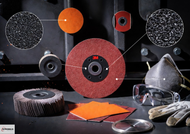
Abrasives Explained: Types, Grit & Materials
Mar 31st 2026
A Complete Guide to Abrasives: Types, Uses, Materials & Safety
Abrasives are essential tools in workshops, factories, and job sites everywhere. Whether you're smoothing rough metal edges, preparing surfaces for painting, or achieving a mirror-like polish, the right abrasive makes the job faster, cleaner, and more professional.
At Strobels Supply, we stock high-quality abrasive products from trusted brands like 3M including Scotch-Brite pads, sanding discs, and compatible tools to help professionals get reliable results. In this guide, we'll cover the fundamentals so you can choose the best abrasive for your needs and use it safely.
What Are Abrasives?
Abrasives are hard, sharp materials designed to remove small amounts of material from a workpiece through friction and mechanical action. They act like thousands of tiny cutting tools that grind, cut, sand, shape, polish, or clean surfaces.
- Meaning and purpose — The abrasive grain is harder than the material it's working on, so it shears or fractures the surface while the workpiece wears down the abrasive slightly (exposing fresh edges in good products).
- Everyday examples — Sandpaper for woodworking, grinding wheels for metal fabrication, Scotch-Brite pads for surface prep, diamond blades for cutting tile or stone.
- Common uses — Metalworking (deburring, grinding welds), woodworking (sanding furniture), automotive (paint prep and polishing), construction (surface conditioning), and industrial finishing.
Types of Abrasives
Abrasives come in different forms depending on how the grains are held together and their intended use. Here's a breakdown of the main categories:
-
Bonded Abrasives
Grains are fused with a bonding agent (like resin or vitrified ceramic) into rigid shapes.
Examples — Grinding wheels, cut-off discs, sharpening stones.
Best for — Heavy stock removal, precision grinding, cutting metal or stone. -
Coated Abrasives
Grains are glued to a flexible backing (paper, cloth, or film) in layers.
Examples — Sandpaper sheets, sanding belts, flap discs, fiber discs.
Best for — Sanding, finishing, blending, light-to-medium removal on wood, metal, or composites. -
Superabrasives
Use ultra-hard grains like diamond or cubic boron nitride (CBN) for tough jobs.
Examples — Diamond grinding wheels, CBN tools.
Best for — Hard materials like ceramics, glass, hardened steels, or composites where regular abrasives wear out quickly. -
Non-Woven Abrasives
Grains embedded in a flexible, open web of fibers (often nylon) with resin bonding — cushioned and conformable.
Examples — Scotch-Brite pads, surface conditioning discs.
Best for — Cleaning, deburring, blending, scuffing, and uniform finishes without heavy stock removal. Great for pre-paint prep or rust removal.
Natural vs. Synthetic Abrasives
|
Property |
Natural Abrasives |
Synthetic Abrasives |
|
Source |
Mined from earth (garnet, emery, corundum, diamond) |
Manufactured chemically (aluminum oxide, silicon carbide, CBN) |
|
Consistency |
Variable — grain size/purity varies by deposit |
Highly consistent — controlled manufacturing |
|
Hardness control |
Limited |
Engineered to exact specifications |
|
Cost |
Low-moderate for common types |
Cost-effective at scale for most types |
|
Performance |
Adequate for general tasks |
Superior for precision and demanding applications |
|
Examples |
Garnet, emery, flint, pumice, diamond |
Aluminum oxide, silicon carbide, CBN, zirconia alumina |
Abrasive Grains and Key Properties
Grit Size
Grit size (or grit number) defines how coarse or fine an abrasive is. It refers to the number of holes per linear inch in the mesh screen used to sieve the particles. A lower number = larger, coarser grains; a higher number = smaller, finer grains.
|
Grit Range |
Classification |
Typical Use |
|
16–36 |
Very Coarse |
Heavy material removal, rough shaping, floor sanding |
|
40–80 |
Coarse |
Stock removal, removing old paint/finish |
|
100–150 |
Medium |
General sanding, surface prep |
|
180–220 |
Fine |
Pre-finishing, smoothing between coats |
|
240–320 |
Very Fine |
Final sanding before finishing |
|
360–600 |
Extra Fine |
Polishing, smoothing finishes |
|
800–2000+ |
Ultra Fine / Micro |
Buffing, final polishing, lapping |
Hardness of Common Abrasive Materials
|
Abrasive Material |
Mohs Hardness |
Knoop Hardness (GPa) |
Notes |
|
Diamond |
10 |
~56–102 |
Hardest known material |
|
Cubic Boron Nitride (CBN) |
~9.5 |
~46 |
For hardened steels |
|
Silicon Carbide (SiC) |
9.5 |
~28 |
Brittle, sharp; for non-ferrous metals |
|
Aluminum Oxide (Al₂O₃) |
9.0 |
~21 |
Tough; most widely used |
|
Zirconia Alumina |
~8.5–9 |
~18–21 |
Self-sharpening; for aggressive grinding |
|
Garnet |
7.5–8.5 |
~12–16 |
Natural; woodworking, waterjet |
|
Emery |
7–9 (mixed) |
Variable |
Natural corundum/magnetite blend |
|
Pumice |
6 |
~5–6 |
Mild; used in polishes, dental |
|
Calcium Carbonate |
3 |
~1.6 |
Very mild; toothpaste, soft polishes |
Garnet
Garnet is a naturally occurring silicate mineral used extensively in sandpaper and waterjet cutting. Its hardness (7.5–8.5 Mohs) and sharp fracture edges make it well-suited for woodworking and fine finishing. Garnet grains fracture to produce new sharp edges, extending working life. It is also the primary abrasive medium used in waterjet cutting because it is chemically inert, produces minimal secondary waste, and is recyclable.
Zirconia Alumina
Zirconia alumina (zirconium oxide + aluminum oxide) is a premium coated abrasive grain engineered for tough grinding and metalworking applications. It is self-sharpening — under pressure it micro-fractures to expose fresh cutting edges — making it exceptionally durable on stainless steel, high-alloy steels, and titanium. It is commonly found in abrasive belts used in heavy-duty fabrication and weld blending.
Diamond Abrasives
Diamond abrasives are available in natural and synthetic forms (polycrystalline diamond, PCD). Synthetic diamond dominates industrial use because it can be produced in controlled sizes and shapes. Diamond abrasives are used for grinding, lapping, and polishing of ceramics, glass, stone, carbides, and composites. They are typically bonded in metal matrices (for rough grinding) or resin matrices (for fine finishing).
How Abrasives Work
Abrasives remove material through friction:
- Sharp grains penetrate and cut tiny chips from the surface (like micro-machining).
- Friction generates heat; pressure and speed control the process.
- Friable grains fracture to reveal new edges; dull grains reduce efficiency.
- Surface finish — Coarser grits remove material fast but leave scratches; finer grits refine for smoothness. Lubricants or lower pressure help control heat and finish.
Why Most Abrasives Are Synthetic
While natural abrasives exist, synthetics dominate because:
- Consistency — Uniform size, shape, and purity for predictable performance.
- Tailored properties — Engineered hardness, toughness, or friability for specific tasks.
- Better performance — Longer life, faster cutting, less variability.
- Cost-effectiveness — Mass production lowers long-term costs; reliable supply avoids mining fluctuations.
- Advantages in practice — Ideal for high-volume industrial work where repeatability matters.
Safety When Using Abrasives

Abrasives involve high speeds, dust, noise, and vibration — always prioritize safety:
- Wear PPE: Safety glasses/goggles, dust mask or respirator (for airborne particles), hearing protection, gloves, and protective clothing.
- Use guards on power tools; never remove them.
- Inspect abrasives for damage/cracks before use; don't use dropped or expired products.
- Match speed/RPM to tool and abrasive ratings.
- Secure workpieces to prevent kickback.
- Control dust with ventilation or extraction; avoid breathing particles.
- Use correct pressure/angle; excessive force causes overheating or breakage.
- Follow ANSI/OSHA guidelines and manufacturer instructions.
With the right abrasive and safe practices, you'll achieve better results with less effort. Explore our range of 3M abrasives, Scotch-Brite products, and more at Strobels Supply. We're here to help you find the perfect solution for your project.