
 US Dollars
Cartridge Rolls: Grits, Shapes & Mandrel Selection
Apr 28th 2026
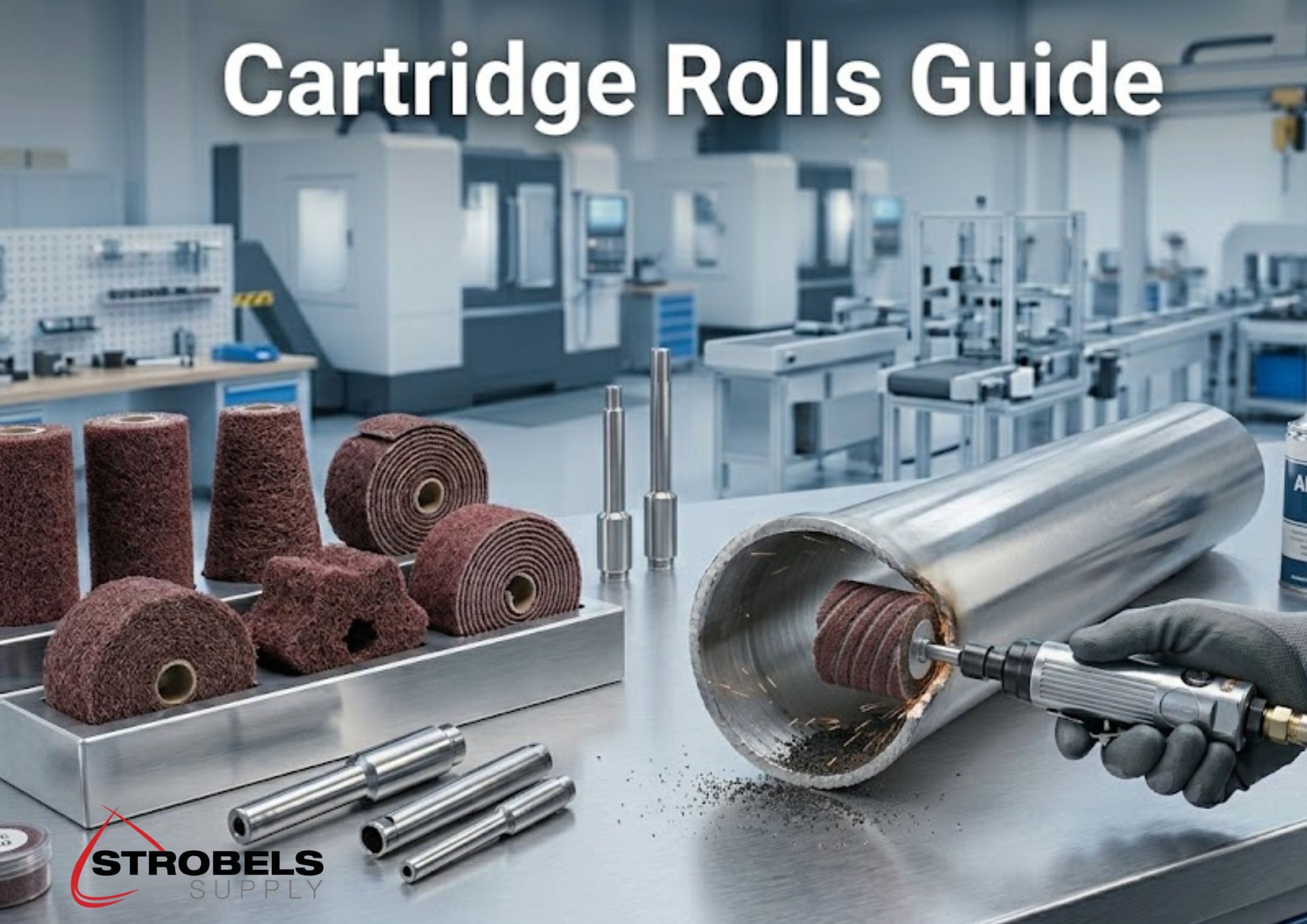
Cartridge Rolls: Complete Guide to Types, Grits, Applications & Mandrels
Construction, shapes, grain types, grit selection, mandrels, RPM limits, porting applications, and a brand-by-brand comparison everything machinists, fabricators, and engineers need to specify and use cartridge rolls correctly.
SPECIALTY ABRASIVESUPDATED 20253M · PFERD · NORTON MERIT · STANDARD ABRASIVES
What's In This Guide
- What Are Cartridge Rolls?
- Straight, Tapered & Spiral Shapes
- Grain Types: A/O, Ceramic, Zirconia
- Grits, Sizes & Reading a Spec
- Applications & Tooling
- Porting Cylinder Heads
- Cartridge Rolls vs Cones, Flap Wheels & Points
- Mandrels, Holders & Accessories
- Brand & Product Line Comparison
- How to Choose the Right Roll
- Operating Technique & Grit Sequences
- Safety, Mandrel Care & Roll Changeout
// 01
What Are Cartridge Rolls?
A cartridge roll is a coated abrasive tool formed by taking a strip of abrasive-coated cloth or paper, rolling it at a defined angle, and gluing it into a solid cylindrical shape. The cylinder mounts over a threaded mandrel, which in turn chucks into a die grinder, drill, or other rotary tool. As the roll spins and contacts the workpiece, the outermost abrasive layer wears down and the cloth backing frays — exposing the next layer of fresh abrasive beneath it. This layer-by-layer cutting action is what makes cartridge rolls so consistent: as the outermost abrasive layer wears down, the cloth backing frays to expose fresh abrasive layers for continued cutting action.
The technical term "cartridge" comes from the roll's ammunition-cartridge-like construction — a tightly packed cylinder with consistent density from outside to core. This construction keeps the roll true and balanced at speed, and ensures that grit exposure remains consistent across the working life of the product.
Where Cartridge Rolls Fit Among Rotary Abrasives
Among die grinder abrasives, cartridge rolls occupy a specific and non-substitutable position. They are not the most aggressive tool available — flap wheels and grinding points remove material faster. They are not the finest — polishing sticks and felt bobs reach lower Ra values. What they are is the most practical combination of reach, conformability, and finish consistency for the specific class of work that defines their market: inside diameters, tight radii, weld zones, and precision finishing in confined access.
|
Tool Type |
Access |
Removal Rate |
Finish Quality |
Cartridge Roll Advantage |
|
Cartridge Roll |
Excellent — IDs, bores, recesses |
Moderate |
Medium to fine |
Consistent layer-by-layer cutting; wide grit range |
|
Abrasive Cone |
Good — tapered features |
Moderate–High |
Coarse to medium |
Better for countersinks; less finish control |
|
Mounted Grinding Point |
Moderate |
High |
Coarse |
More aggressive; removes base metal; not for finish work |
|
Flap Wheel |
Moderate — contoured ODs |
Moderate |
Medium to fine |
Better for external contoured work; poor ID access |
|
Cross Buff / Non-Woven Star |
Excellent — ID only |
Low |
Fine to very fine |
No stock removal; finishing and conditioning only |
|
Spiral Band |
Good — OD contours |
Moderate |
Medium |
Better for OD profile work; less effective inside bores |
// 02
Straight, Tapered & Spiral: Choosing the Right Shape
Shape is the first selection decision — before grain, grit, or brand. The geometry of your workpiece determines which profile reaches the surface you need to work.
Shape Type 01
Straight (Untapered) Roll
- ProfileUniform diameter from end to end — a perfect cylinder
- Best forInside diameters, bores, tubes, weld zones with uniform wall geometry
- ContactFull side contact with bore wall — maximum cutting width per pass
- AccessRequires bore/recess large enough for full roll diameter to enter
- Typical useDeburring drilled holes, cleaning hydraulic bore IDs, weld blending in tubes
- 3M product341D Straight (most common, available 1/4 in – 1 in diameter)
Shape Type 02
Full Tapered Roll
- ProfileTapered to a point at the working end — cone-shaped tip
- Best forCorners, crevices, inside radii, flash removal on castings
- ContactPoint and angled tip contact — reaches where straight roll cannot enter
- AccessCan enter features smaller than the roll body — tip leads the way
- Typical useFlash removal on medical devices and car parts; finishing inside corners; mold and die work
- 3M product341D Full Tapered — tapered tip allows grinding and finishing in tight spaces, corners, and crevices
Shape Type 03
Spiral Roll
- ProfileAbrasive strip rolled at a steep angle — helical grain pattern on surface
- Best forContoured and curved surfaces, aggressive stock removal, porting work
- ContactHelical abrasive pattern produces aggressive cutting at any contact angle
- AccessMore aggressive than straight; works on OD contours as well as IDs
- Typical useEngine porting (cylinder heads, intake manifolds), weld removal, heavy blending
- NoteNorton Merit and PFERD both offer spiral configurations for porting applications
ℹ Partial taper vs. full taper: Some manufacturers offer a half-taper (tapered at the tip only, straight body). Half-taper rolls provide a pointed entry into tight features while maintaining a wider working body for more cutting contact. When ordering, confirm whether you need a full taper (sharper entry, less cutting surface) or a straight body with a tapered tip.
// 03
Grain Types: Aluminum Oxide, Ceramic, Zirconia & Blends
The grain determines how aggressively a cartridge roll cuts, how long it lasts, and what materials it handles well. The wrong grain is the number-one reason shops experience poor performance from cartridge rolls that should be working correctly.
Aluminum Oxide (A/O)
Hardness
9 Mohs — hard enough for all common metals
Cut rate
Moderate to fast; self-fractures to expose fresh edges
Life
Good for general use; shorter than ceramic on hard alloys
Materials
Steel, stainless steel, cast iron, aluminum, ferrous alloys, wood
Best for
Everyday metalworking, weld blending, deburring, ID work on mild to medium-hard materials
Example
3M 341D — industry standard general-purpose cartridge roll
Ceramic Alumina
Hardness
~9 Mohs — micro-fractures under pressure to self-sharpen
Cut rate
Fastest of all grain types; consistent throughout roll life
Life
Significantly longer than aluminum oxide on steel and high-alloy materials
Materials
Hardened steel, high-alloy steels, stainless steel, titanium
Best for
High-volume production, demanding metalworking, when cost-per-part (not unit cost) is the metric
Example
3M 747D Ceramic Aluminum Oxide — highest cut rate in the 3M cartridge roll family
Zirconia Alumina
Hardness
~8.5–9 Mohs — tough, self-sharpening under heavy pressure
Cut rate
High under load — performs better than A/O when pressure is applied
Life
Longer than A/O on ferrous metals; better suited to heavy-duty grinding
Materials
Steel, high-alloy steels, stainless steel — particularly under high pressure
Best for
Heavy deburring, aggressive blending on steel and stainless where pressure is applied
Note
Less common in cartridge roll format than in belts and discs; available from specialty suppliers
Blends & Premium Mixes
What they are
Manufacturer-formulated combinations of A/O with ceramic or zirconia for balanced performance
Goal
Cut rate between standard A/O and pure ceramic, at lower cost than premium ceramic
Materials
Broad — engineered for specific applications by each manufacturer
Best for
Shops needing better-than-standard performance without full ceramic pricing
Example
Some Norton Merit precision AO lines use enhanced mineral blends for extended life
When to Upgrade from Aluminum Oxide to Ceramic
The classic economic calculation: a ceramic cartridge roll costs approximately 2–3× more per unit than an equivalent aluminum oxide roll. On mild steel or aluminum, this premium is rarely justified. On hardened steels, stainless, or high-volume production work, the calculus reverses quickly. If you are changing aluminum oxide rolls more than two or three times per part, or if performance degrades noticeably during a run, ceramic is almost certainly the correct specification.
? Rule of thumb: If a ceramic roll lasts 3× longer and cuts 25% faster on your specific material, it produces approximately 3.75× the output per dollar compared to a standard aluminum oxide roll — even at 3× the unit price. Track parts per roll, not cost per roll.
// 04
Grits, Sizes & How to Read a Cartridge Roll Specification
How to Read a Cartridge Roll Spec
Every cartridge roll specification encodes five critical parameters. Understanding them means you can order the exact right product every time — and substitute intelligently across brands when needed.
3M 341D — 1/2 in × 1-1/2 in × 1/8 in — A/O 80 Grit — X-Weight — 18,000 RPM max
1/2 inRoll Diameter
1-1/2 inRoll Length
1/8 inMandrel Hole (Center Hole)
80 GritAbrasive Grade
18,000 RPMMaximum Speed
Roll diameter determines what size opening the roll fits inside. Select a roll 10–15% smaller than the bore to allow proper flex and wall contact. Roll length determines how far into a bore the roll reaches and how much cutting surface you have per pass. Mandrel hole must exactly match your mandrel's pilot diameter — this is not approximate. Grit governs finish and removal rate (see chart below). Max RPM is a hard safety limit inversely related to roll diameter: smaller diameter = higher max RPM.
Available Sizes: Common Dimensions
|
Roll Diameter |
Common Lengths |
Mandrel Hole |
Typical Max RPM |
Best For |
|
1/4 in |
1 in, 1-1/2 in |
1/8 in |
25,000 RPM |
Very small bores, fine detail work, rotary tools |
|
3/8 in |
1 in, 1-1/2 in |
1/8 in |
24,000 RPM |
Small ID work, drilled hole deburring, tight radii |
|
1/2 in |
1 in, 1-1/2 in |
1/8 in |
18,000–24,000 RPM |
General die grinder work — most versatile size |
|
3/4 in |
1 in, 1-1/2 in |
1/8 in or 1/4 in |
16,000 RPM |
Larger ID work, porting, manifold finishing |
|
1 in |
1-1/2 in, 2 in |
1/4 in |
12,000–16,000 RPM |
Large bore work, porting larger ports, external blending |
|
1-1/4 in |
1-1/2 in, 2 in |
1/4 in |
10,000–12,000 RPM |
Porting, heavy blending, large access features |
⚠ Critical sizing rule: The center hole diameter of the cartridge roll must exactly equal the diameter of the mandrel pilot. To ensure correct fit, the center hole diameter of the cartridge roll must be equal to the diameter of the mandrel pilot inserted into the cartridge roll. An oversize hole creates eccentric runout and vibration; an undersize hole risks splitting the roll under centrifugal force.
Grit Selection: The Full Range
|
Grit Range |
Class |
Scratch Pattern |
Removal Rate |
Typical Application |
|
36–60 |
Coarse |
Deep, visible grooves |
Very high |
Heavy stock removal, aggressive weld blending, rough porting, scale removal |
|
80–100 |
Medium Coarse |
Moderate scratches |
High |
Deburring holes and edges, weld blending, initial surface prep, porting first pass |
|
120–150 |
Medium |
Light scratch pattern |
Moderate |
Intermediate blending, removing coarser scratches, pre-finishing metalwork |
|
180–240 |
Fine |
Fine scratches, consistent Ra |
Low–Moderate |
Surface conditioning before coating, final blending, ID polishing, porting finish pass |
|
320–400 |
Very Fine |
Near-smooth surface |
Low |
Pre-polish metalwork, fine finishing on soft metals, inspection prep |
|
400+ |
Ultra Fine |
Micro-scratches |
Very low |
Final finishing prior to buffing or plating, highly polished porting work |
? Starting grit selection: For most metalworking deburring and ID finishing, 80–120 grit is the practical workhorse range. Start with the coarsest grit that accomplishes your primary task efficiently — starting too fine wastes time and product life. Reserve 36–60 grit for genuine stock removal or weld blending tasks, not general conditioning.
Backing Weight: X-Weight vs J-Weight
The backing material affects how the roll behaves under load. The 3M 341D uses X-weight (extra-heavy) cloth backing — tough, durable, supports heavy sanding and provides a cloth backing that supports heavy sanding yet frays to expose fresh abrasive. J-weight (jeans-weight) cloth is lighter and more flexible — used in finishing applications and on contoured surfaces where conformability matters more than durability. For standard metalworking cartridge roll applications, X-weight is the correct default.
// 05
Applications & Tooling
Core Metalworking Applications
Deburring Drilled Holes and Punched Features
This is the highest-volume use case in manufacturing. Every drilled, punched, or EDM-cut hole creates a burr that must be removed before assembly. A straight cartridge roll at the correct diameter — inserted into the hole and run at proper speed — removes the burr consistently and leaves a controlled chamfer-like edge that assembles cleanly. Grit selection: 80–120 for most ferrous metals; 120–180 for aluminum and non-ferrous parts where edge radius control is tighter.
Cleaning and Finishing ID Bores
Inside diameters of hydraulic cylinders, valve bodies, pump housings, and bearing housings require surface conditioning after machining. Cartridge rolls reach bore walls that are completely inaccessible to standard abrasive discs. The straight roll geometry produces uniform contact across the bore circumference when operated with steady in-and-out motion. Grit selection: 120–180 for cleaning and light conditioning; 240–320 for fine surface finish prior to honing or final assembly.
Refining Welds in Confined Spaces
Weld refinement inside tube structures, pipe joints, and chassis assemblies requires a tool that can enter the space and blend the weld bead flush with the parent material. A straight cartridge roll — with the die grinder positioned axially along the tube — blends the weld progressively with each pass. Grit selection: 60–80 to break down the weld crown; 120 to blend; 180 for final conditioning.
Radiusing Edges and Breaking Sharp Corners
Aerospace, medical device, and precision engineering applications often specify that all internal edges must carry a controlled radius (no sharp 90° corners) to prevent stress concentration cracking. A tapered cartridge roll, worked along the edge, produces a consistent radius far more controllably than grinding points or burrs.
Cartridge Rolls for Die Grinders: Speed and Safety
The die grinder is the primary tool for cartridge rolls in production and maintenance environments. Key performance parameters:
|
Die Grinder Type |
Speed Range |
Cartridge Roll Size Compatibility |
Notes |
|
Standard air die grinder |
18,000–25,000 RPM |
1/4 in – 1/2 in diameter rolls |
Most common tool — matches the majority of 1/8 in shank mandrels |
|
Variable-speed die grinder |
3,000–25,000 RPM |
1/4 in – 1 in diameter rolls |
Best for larger rolls that require lower RPM — essential for 3/4 in+ diameters |
|
Angle die grinder |
10,000–20,000 RPM |
1/2 in – 1 in diameter rolls |
Provides better access angle for some porting and ID work |
|
Extended-reach die grinder |
18,000–25,000 RPM |
1/4 in – 1/2 in diameter rolls |
Used with long-shank mandrels for deep bore work |
|
Electric rotary tool (Dremel) |
5,000–35,000 RPM |
1/4 in – 3/8 in diameter rolls |
Lighter duty; suitable for small-scale finishing work |
// 06
Porting Cylinder Heads and Manifolds
Engine porting is one of the most demanding cartridge roll applications — and the one where product selection has the most direct impact on the outcome. A ported cylinder head can yield meaningful power gains on performance engines, but only if the surface quality, port shape, and transition geometry are correct. Cartridge rolls are the primary abrasive tool for this work.
Why Porting Requires Cartridge Rolls (Not Grinding Points or Burrs)
Tungsten carbide burrs are the traditional porting tool for aggressive material removal — they are excellent at reshaping port geometry. But they leave a rough, irregular surface that increases turbulence in the airflow. Cartridge rolls follow burr work to progressively refine that surface, blending tool marks and producing the smooth, directional finish that maximizes port flow efficiency. The layer-by-layer exposure of fresh abrasive in cartridge rolls creates a more consistent scratch pattern than grinding points, which dull rapidly on aluminum and cast iron port surfaces.
Recommended Grit Progression for Porting
1
Rough Shape with Carbide Burr or Coarse Cartridge Roll
Remove casting flash, open port to target shape, blend valve guide bosses. This is aggressive stock removal — geometry shaping, not surface finishing.
Cartridge roll: Spiral or straight, 36–60 grit, 3/4–1 in diameter. Carbide burr for initial heavy shaping preferred by many porters.
2
Blend Tool Marks — Medium Cartridge Roll
Remove burr tracks and rough shaping marks. This pass establishes the surface character of the port — consistent scratch direction with the airflow is the goal.
Cartridge roll: Straight or spiral, 80–100 grit, 3/4 in diameter. Work with the port direction.
3
Intermediate Finishing
Refine the surface, remove 80-grit scratches. Approach final port shape — no geometry changes at this stage, only surface quality improvement.
Cartridge roll: Straight, 120–150 grit, matching port diameter. Light pressure, consistent motion.
4
Fine Port Finish
Final surface conditioning. Porting theory favors a slightly rough texture in intake ports (to prevent fuel dropout on wet-flow ports) and a smooth finish on exhaust ports (to resist carbon buildup). Adjust accordingly.
Intake: 180–220 grit for a slightly textured finish. Exhaust: 240–320 grit for a smoother, more polished surface.
5
Combustion Chamber Polish (Optional)
If a mirror polish is desired on the combustion chamber dome to reduce carbon retention and heat absorption, follow with 400+ grit cartridge roll or polishing roll, then polishing compound.
400+ grit, smallest diameter roll that fits the chamber geometry. Non-woven buff or polishing roll for final stage.
ℹ Norton Merit Porting Kit: The Norton Merit Porting Test Kit is specifically designed for cylinder head and manifold work, including tapered stones, grind-polishing rolls in assorted sizes and grits, and a mini Grind-O-Flex wheel — a popular choice for shops that work on performance engines or head-flow testing. Available through Strobels Supply.
// 07
Cartridge Rolls vs Cones, Flap Wheels & Grinding Points
Knowing when to reach for a cartridge roll — and when to reach for something else — separates efficient shops from frustrated ones. Each tool has a distinct performance profile that makes it the right choice for specific conditions.
|
Situation |
Best Tool |
Why |
|
Deburring a drilled through-hole (< 3/4 in diameter) |
Straight cartridge roll |
Exact diameter match; clean, consistent chamfer; no geometry damage |
|
Deburring a countersunk or tapered hole |
Tapered cartridge roll or abrasive cone |
Taper geometry matches the feature; abrasive cones are often faster for very aggressive countersink work |
|
Blending a weld inside a closed section |
Straight cartridge roll |
Reaches inside; grit progression available from 60 to 240; no substitute |
|
Conditioning a contoured external surface (OD profile) |
Flap wheel or spiral band |
Cartridge rolls are not optimized for OD convex profiles; flap wheels conform better |
|
Heavy stock removal from cast iron port |
Carbide burr first, then spiral cartridge roll |
Burrs remove most efficiently; cartridge rolls follow for finish |
|
Finishing the ID of a long, deep bore (3+ inches deep) |
Long-shank mandrel + cartridge roll |
Extended-reach mandrel provides access; abrasive cones do not have the length |
|
Final surface conditioning before coating/plating |
Non-woven cross buff or star (after cartridge roll sequence) |
Non-woven removes all stress risers without affecting geometry; cartridge roll does the grit work first |
|
Cleaning scale or oxidation from a flat surface inside a box section |
Cross & square pad on mandrel |
Flat pad geometry contacts flat surface; cartridge roll would not achieve full flat contact |
// 08
Mandrels, Holders & Accessories
The mandrel is not an accessory — it is a critical component of cartridge roll performance and safety. A mismatched, worn, or bent mandrel produces vibration, eccentric roll wear, inconsistent finish, and significantly increased risk of roll failure at speed.
What Is a Cartridge Roll Mandrel?
A mandrel is a solid metal shaft with a threaded, tapered, or straight pilot pin at the working end. The cartridge roll slides over the pilot pin; the mandrel is then chucked into the die grinder collet via its shank end. When the tool runs, the pilot holds the roll concentric to the mandrel axis — any pilot wear or eccentricity translates directly into roll runout and finish degradation.
1/8 in Shank Mandrel (Short)
Shank
1/8 in diameter — fits standard die grinder collets
Pilot
1/8 in diameter — fits rolls with 1/8 in center hole
Length
Typically 1.5–2 in total length
Use
Standard reach work; most die grinder cartridge roll applications with 1/4 in – 3/4 in rolls
Speed
Rated for high RPM (up to 25,000 RPM on some designs)
1/4 in Shank Mandrel (Standard)
Shank
1/4 in diameter — fits 1/4 in collet die grinders and drill chucks
Pilot
1/4 in diameter — fits rolls with 1/4 in center hole
Length
Typically 2–3 in total length
Use
Larger rolls (3/4 in – 1-1/4 in diameter); more rigidity for heavier work
Speed
Lower max RPM than 1/8 in — check product data
Extended Reach / Long Shank
Shank
1/8 in or 1/4 in diameter, extended length
Pilot
Matching pilot for roll center hole
Length
4–6 in or longer for deep bore access
Use
Deep bore work, long ID passages, hard-to-reach weld zones
Caution
Longer shank amplifies vibration — reduce RPM; inspect more frequently
CR-9 / Generic Mandrel Types
3M CR type
3M's proprietary mandrel designation; matched to 3M cartridge roll pilots
Generic
Available from many suppliers; cross-reference pilot diameter and shank size carefully
Norton type
Merit mandrel designed for Norton cartridge and spiral rolls
PFERD type
Matched to PFERD POLIROLL® sizing; confirm compatibility before mixing brands
Mandrel Inspection and Replacement Criteria
Replace a mandrel immediately if you observe any of the following: visible bend or bow in the pilot or shank; wear on the pilot that allows the roll to wobble; thread damage on the pilot; corrosion pitting on the pilot seating surface; or if the roll runs visibly eccentric (not true) at speed. Mandrel cost is trivial compared to the cost of workpiece damage or injury from a failed roll at speed.
⚠ Brand cross-compatibility: Not all mandrels are interchangeable across brands. The pilot diameter and thread (if any) must match the roll's center hole. A 1/8 in pilot fits a 1/8 in center hole roll regardless of brand — but the seating geometry and pilot length vary. Always confirm compatibility, especially when mixing 3M rolls with generic mandrels or vice versa.
// 09
Brand & Product Line Comparison
The cartridge roll market is concentrated around a few major brands that define quality standards. Here is an honest, specification-based comparison of the lines most relevant to industrial buyers.
⬛ 3M — 341D & 747D
- 341D: Aluminum oxide, X-weight cloth backing, heat-resistant resin bond. Grits 36–320. Sizes 1/4 in – 1 in diameter. The industry benchmark for general-purpose cartridge roll work.
- 747D: Ceramic aluminum oxide grain for faster cut and longer life on steel and high-alloy materials. Same size and spec range as 341D — a drop-in upgrade for demanding applications.
- Shapes: Straight and full tapered available in both lines.
- Backing: X-weight cloth — tough, supports heavy sanding yet frays consistently to expose fresh abrasive.
- Best for: Production metalworking, weld blending, deburring. 747D for high-alloy or high-volume work.
? PFERD — POLIROLL®
- PFERD's POLIROLL® line offers untapered (cylindrical) and tapered cartridge rolls in aluminum oxide on cloth backing.
- Available sizes: 1/4 in, 3/8 in, 1/2 in diameter × 1 in and 1-1/2 in lengths. Center hole 1/8 in.
- Max RPM: 24,000–25,000 RPM for smaller diameters; 18,000 RPM for 1/2 in diameter.
- Grits: 60, 80, 120 in standard stocking. Pack sizes: 50 per pack — cost-effective for shop-floor use.
- Best for: Shops already invested in PFERD tooling ecosystem; European manufacturing environments. Consistent quality, professional-grade performance.
? Norton — Merit AO Series
- Cartridges are strips of abrasive cloth rolled and glued to form a solid shape that is designed to break down during use and reveal the next layer of abrasive. Mounted on a mandrel and used on high-speed grinders on inside surfaces and inside corners.
- Merit AO series covers standard grits from fine through coarse in both straight and tapered profiles.
- Merit Cartridge Roll Test Kit: Over 120 pieces of the most popular sizes, grits, and shapes with appropriate mandrels included — ideal for shops qualifying cartridge rolls for a new application.
- Merit Porting Kit: Includes porting-specific rolls, stones, and accessories. Purpose-built for cylinder head and manifold work.
- Best for: Shops wanting a complete cartridge roll assortment from a single trusted source; automotive and porting applications.
? Standard Abrasives™ (3M)
- Standard Abrasives is 3M's industrial abrasives sub-brand, covering the full specialty range including cartridge rolls, spiral bands, mounted points, and cross buffs.
- Precision AO cartridge rolls: Tight dimensional tolerances for automated finishing applications where runout must be minimized.
- Available in straight configurations; aluminum oxide mineral on cloth backing; multiple grit options.
- Designed for integration with the broader Standard Abrasives finishing system — compatible mandrels and accessories across the product family.
- Best for: Production environments running automated finishing; shops that specify Standard Abrasives across multiple product categories for system consistency.
Comparing Across Brands for the Same Grit and Size
When two cartridge rolls share the same diameter, length, center hole, and grit number, they will produce similar results on the same application — the grain chemistry and backing weight are more important differentiators than the brand name. Use these criteria to compare cross-brand:
|
Comparison Factor |
What to Look For |
Why It Matters |
|
Grain type |
A/O vs ceramic vs zirconia — not just "80 grit" |
Determines cut rate and life on your specific material |
|
Backing weight |
X-weight (heavy, durable) vs J-weight (lighter, more flexible) |
X-weight lasts longer under pressure; J-weight conforms better |
|
Glue type |
Confirm heat-resistant resin bond vs standard resin |
Heat-resistant resin maintains bond under high-friction conditions |
|
Dimensional tolerance |
Run a sample of 10 — measure OD variation |
Tight tolerance = better concentricity = less vibration = better finish |
|
Pack quantity |
Price per roll, not pack price |
Higher pack quantities (50–100 per pack) reduce per-unit cost significantly |
// 10
How to Choose the Right Cartridge Roll
Five decisions, made in order. Answer each one before moving to the next.
1
What is the access geometry?
Cylindrical bore or tube ID → straight roll. Corner, crevice, or tapered feature → tapered roll. Contoured surface with heavy material removal needed → spiral roll. External contoured profile → flap wheel or spiral band (not a cartridge roll).
2
What is the feature size?
Choose roll diameter 10–15% smaller than the bore. Choose roll length long enough to cover the bore depth in 2–3 passes without the mandrel contacting the workpiece. Confirm your tool has the correct collet size for the mandrel shank.
3
What material are you working?
Mild steel, stainless, cast iron, or general ferrous → aluminum oxide (341D) to start; ceramic (747D) if high-volume or hard alloy. Aluminum, brass, non-ferrous → aluminum oxide; avoid zirconia (too aggressive on soft metals). Titanium or high-alloy → ceramic or zirconia.
4
What is the task: removal, blending, or finishing?
Heavy removal/weld blending → 36–80 grit. Intermediate blending → 80–120 grit. Final conditioning → 150–240 grit. Pre-polish/inspection prep → 320–400 grit. Start one grit step coarser than you think you need — it is easier to progress to finer than to compensate for underperforming with too-fine a grit.
5
What tool speed is available?
Confirm your die grinder RPM range. Check the max RPM on the roll you've selected. If your grinder runs at 25,000 RPM, you cannot safely use a 3/4 in diameter roll rated at 16,000 RPM without a speed-controlled tool. Never exceed rated max RPM.
// 11
Operating Technique & Grit Step-Down Sequences
For Inside Diameter Work
Insert the spinning roll into the bore at operating speed. Move with a steady axial (in-and-out) motion — do not hold the roll stationary against the bore wall. The axial motion distributes wear evenly across the roll length and prevents grooving the bore. Simultaneously, rotate the workpiece or the tool by 90° between passes to ensure circumferential coverage. Apply light to moderate pressure — the roll's layer-by-layer cutting action does not require force; forcing the tool compresses the layers, reduces cutting efficiency, and generates heat that degrades the resin bond.
For Weld Blending
Approach the weld at a shallow angle (15–20° from the surface), not perpendicular. Perpendicular approach concentrates cutting on a small contact strip; shallow approach distributes cutting across a wider zone and produces a blend that tapers into the parent metal naturally. Work with the weld direction on the first pass, then blend across the weld on subsequent finer passes.
Grit Step-Down Sequence — General Metalworking
|
Pass |
Grit |
Purpose |
Check Before Moving On |
|
Pass 1 — Material removal |
60 or 80 |
Remove weld bead, burr, scale, or heavy material |
All major surface defects are gone; consistent scratch pattern present |
|
Pass 2 — Blend |
100 or 120 |
Remove Pass 1 scratches; blend into parent metal |
No 60/80-grit scratches visible under a raking light |
|
Pass 3 — Pre-finish |
180 |
Remove 120-grit scratches; approach final surface quality |
Consistent, fine scratch pattern across the worked area |
|
Pass 4 — Finish (if required) |
240–320 |
Final surface conditioning; preparation for coating or inspection |
Surface meets specification Ra requirement; consistent appearance |
⚠ Never skip grit steps. Moving from 80 to 180 directly does not work — the 80-grit scratches are too deep for 180-grit to remove efficiently. You will wear through the 180-grit roll, overheat the work surface, and still have 80-grit scratches showing through the final finish. The step-down sequence is not optional — it is the process.
Signs Your Roll Is Worn Out and Needs Replacing
- Cut rate drops noticeably: You are applying the same pressure and speed but removing material significantly slower. Fresh abrasive layers are exhausted.
- Smearing instead of cutting: Dull grain smears soft metals (aluminum, brass) rather than cutting cleanly. Replace immediately — smearing on aluminum in particular causes loading that can contaminate the surface.
- Roll is significantly smaller in diameter: The outer layers have worn through. A 1/2 in roll worn to 3/8 in no longer contacts the intended bore wall geometry — finish quality will be inconsistent.
- Visible separation between layers: If you see the roll starting to delaminate or separate between layers, remove it immediately. A delaminating roll at speed can eject material and cause injury.
- Vibration increases: Uneven layer wear creates eccentricity. Increased vibration is a safety signal as well as a quality signal.
// 12
Safety, Mandrel Care & Roll Changeout
RPM: The Non-Negotiable Limit
Every cartridge roll has a maximum rated RPM printed on the product or its packaging. This number is a hard engineering limit, not a suggestion. Operating above rated RPM generates centrifugal stress in the roll that exceeds the resin bond strength — the result is explosive disintegration of the spinning roll, with fragment ejection velocities sufficient to cause serious injury. Verify tool RPM against roll max RPM before every setup. For variable-speed tools, set the speed before starting.
|
Roll Diameter |
Typical Max RPM |
Compatible Tool |
RPM Check Required? |
|
1/4 in |
25,000 RPM |
Most standard die grinders ✓ |
Usually safe with standard tools |
|
3/8 in |
24,000 RPM |
Most standard die grinders ✓ |
Usually safe with standard tools |
|
1/2 in |
18,000–24,000 RPM |
Confirm tool RPM |
ALWAYS check — 25,000 RPM tool exceeds 18,000 rated roll |
|
3/4 in |
16,000 RPM |
Variable-speed grinder only |
CRITICAL — must use variable-speed tool |
|
1 in+ |
12,000–16,000 RPM |
Variable-speed grinder only |
CRITICAL — cannot use standard-speed die grinder |
Roll Changeout Procedure
Stop the tool completely and allow it to come to a full stop before changing rolls. Never attempt to remove a roll while the mandrel is spinning, even slowly. Unscrew the worn roll from the mandrel pilot by rotating it in the reverse direction from the tool's operating rotation — the same direction the tool spins tends to tighten the roll further onto the pilot. Inspect the pilot for wear, corrosion, or damage before installing the fresh roll. The roll should slide onto the pilot without forcing, and should seat firmly without rattle or wobble.
PPE Requirements
- Eye protection: Safety glasses minimum; face shield strongly recommended for all die grinder cartridge roll work. Metal chips from deburring operations travel at significant velocity.
- Hearing protection: Die grinders operate at 85–100 dB — above OSHA's 90 dB action level for extended exposure. Use earplugs or earmuffs for any sustained grinding session.
- Respiratory protection: Metal dust from grinding is an inhalation hazard. Use a P100 respirator for ferrous metal work; a half-face respirator is appropriate for most cartridge roll deburring operations in adequately ventilated spaces.
- Hand protection: Cut-resistant gloves protect against contact with the rotating roll and metal chips. Do not use loose-fitting gloves that could catch on the tool.
⛔ Never modify a cartridge roll. Do not cut, trim, or reshape a roll. Do not attempt to repair a delaminating roll with adhesive. Do not use a roll with visible damage. The structural integrity of the roll under centrifugal load is designed into the manufactured product any modification changes those parameters unpredictably.
Find the Right Cartridge Roll
for Your Application
Strobels Supply stocks 3M 341D and 747D cartridge rolls, PFERD POLIROLL®, Norton Merit AO series, compatible mandrels, and full accessory kits — in every common size, shape, and grit from 36 through 320+.
Shop Cartridge Rolls & Specialty Abrasives →
Need help specifying the right product for your job? Contact our technical team at strobelssupply.com