
 US Dollars
Cross Buffs & Non-Woven Stars: Grade Guide
Apr 28th 2026
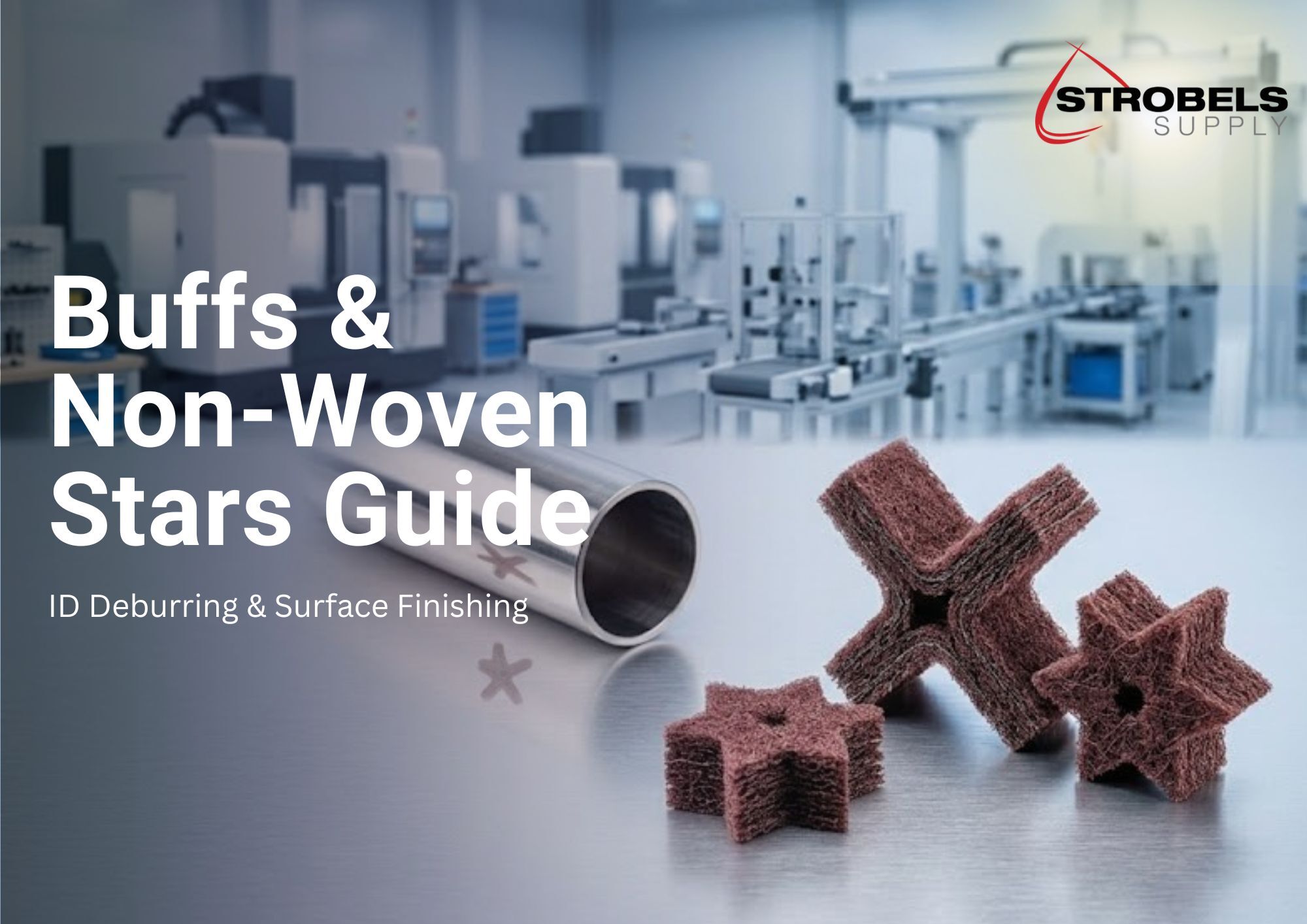
Cross Buffs & Non-Woven Stars: The Expert Guide to Precision ID Finishing
Table of Contents
- What Are Buffs & Non-Woven Stars?
- How They Work vs Traditional Abrasives
- Construction & Manufacturing
- GP vs HP vs HS: Grade Selection Guide
- Sizes, Specs & Color Coding
- Applications by Industry & Task
- Selection, Use & Best Practices
- Frequently Asked Questions (FAQ)
01. What Are Buffs & Non-Woven Stars?
Buffs and non-woven stars are three-dimensional, mandrel-mounted specialty abrasives built from layered non-woven web. When spun, their flexible arms or petals flare outward under centrifugal force, delivering consistent abrasive action inside bores, tubes, valves, and other confined spaces where discs, belts, or wheels cannot reach.
Cross Buffs vs Non-Woven Stars
| Feature | Cross Buff (X-Buff) | Non-Woven Star (Scotch-Brite™ / Surface Conditioning Star) |
|---|---|---|
| Shape | X / cross-shaped arms | Star / radial petals (typically 4–6 points) |
| Contact Pattern | Wider stripe per revolution | More individual contact points |
| Best For | ID cleaning, deburring, polishing; valves, molds, dies | Very small-diameter tube/pipe ID work, light deburring |
| Flexibility | Good (2–3 ply options) | Higher flex in tight IDs |
| Grades Available | GP, HP, HS (VFN to CRS) | Primarily surface conditioning grades (CRS, VFN) |
Both mount on the same standard mandrels (8-32 or 1/4-20 threads) and can be used interchangeably or in sequence.
02. How They Work vs Traditional Abrasives
The open-web nylon structure impregnated with abrasive mineral (aluminum oxide or silicon carbide) creates a self-renewing, conformable cutting action. Swarf escapes through the gaps, reducing loading and heat while maintaining consistent performance.
Unlike rigid bonded or coated abrasives, non-woven tools:
- Conform to irregular surfaces without gouging
- Generate lower heat
- Resist loading
- Deliver more uniform finishes over their life
This makes them ideal for precision ID work where geometry must be preserved.
03. Construction & Manufacturing
The base is a 3D non-woven nylon web impregnated throughout with resin and abrasive mineral. Layers are cut into cross or star profiles, stacked (ply count affects stiffness), and bonded. Higher ply counts and reinforced webs (especially HS) increase durability and tear resistance.
Quality indicators include uniform arm lengths, strong ply bonding, and consistent mineral distribution.
04. GP vs HP vs HS: Grade Selection Guide
Choosing the right material is the most important decision for performance and part quality.
- GP (General Purpose): Silicon carbide on standard nylon web. Softest and most conformable. Best for light cleaning, polishing, and soft metals (aluminum, brass, plated surfaces). Available in VFN, Fine, Medium, Coarse.
- HP (High Performance): Aluminum oxide on durable web. Stiffer and more aggressive for edge deburring (e.g., aluminum extrusions, die cast flash). Primarily VFN.
- HS (High Strength): Reinforced aluminum oxide web for maximum tear resistance and aggressiveness. Ideal for tough ID cleaning, heavy oxidation, and demanding applications. Available in Coarse (CRS), Medium, and finer options.
Quick Selection Table
| Grade | Aggressiveness | Primary Mineral | Best Applications | Typical Metals |
|---|---|---|---|---|
| GP | Low–Medium | SiC | Light polishing, coating removal, final finish | Soft metals, aluminum, brass |
| HP | High | A/O | Edge deburring, flash removal | Aluminum, non-ferrous |
| HS | Highest | A/O (reinforced) | Heavy oxidation, tough ID cleaning, deburring | Steel, stainless, cast iron |
Pro Tip: Start with HS Coarse/Medium for aggressive cleaning, then follow with GP or HS VFN for polishing. Use lubricant on stainless or aluminum to minimize contamination and extend tool life.
05. Sizes, Specs & Color Coding
Common sizes (Diameter × Thickness × Thread × Ply):
- 3/4" to 3" diameters
- Threads: 8-32 (smaller sizes), 1/4-20 (larger)
- Typical: 1-1/2" × 1/2" × 2 Ply × 8-32
Sizing Rule: Choose a buff diameter 10–20% smaller than the bore ID for optimal flex and contact.
Color Coding (primarily for HS line):
- Green: Coarse (most aggressive)
- Blue: Medium
- Maroon: Very Fine
Always verify grade by label — color coding is not universal.
06. Applications by Industry & Task
Excellent for:
- Aerospace: Hydraulic tubing, fuel systems, landing gear components (geometry-critical)
- Automotive: Valve bodies, brake cylinders, transmission components, die cast deburring
- General Fabrication: Mold/die cleaning, pipe/tube ID finishing, surface prep before plating/coating
- Energy & Heavy Industrial: Heat exchanger tubes, plumbing fixtures, wind turbine components
Not suitable for: Heavy stock removal, cutting, or very hard materials (use bonded abrasives or diamond tools instead).
07.Selection, Use & Best Practices
Process Chain Example (Valve Body ID):
- Machining → 2. HS Coarse Cross Buff (deburr/clean) → 3. HS Medium or GP VFN (polish) → 4. Inspection → 5. Coating
How to Choose: Consider bore size, material, task severity, required finish (Ra), and tool RPM capability.
Operating Best Practices:
- Match RPM to buff size (smaller buffs tolerate higher RPM; larger ones need lower speeds — always check product max RPM).
- Use light to moderate pressure and reciprocating motion.
- Lubricants help on stainless/aluminum and reduce loading.
- Inspect before each use; replace if delaminated or worn through mineral.
Safety: Never exceed max RPM. Use eye/face protection, proper respiratory PPE, and secure workpieces. Avoid using worn buffs (risk of nylon smearing or heat buildup).
8. Frequently Asked Questions (FAQ)
Can I use the same buff on stainless and carbon steel?
Technically yes with A/O grades, but dedicate separate buffs for stainless to avoid iron contamination that can cause rust.
Star vs Cross Buff which is better?
Stars excel in very small IDs (<3/4"); cross buffs offer better coverage and versatility for most valve/tube work. Many users combine both.
How long do they last?
Varies widely by application, pressure, and lubricant use. Track parts-per-buff in production for accurate replenishment.
What mandrel do I need?
Match thread size (8-32 or 1/4-20). Strobels Supply stocks compatible mandrels for all sizes.
Ready to Spec the Right Buff or Non-Woven Star?
Strobels Supply stocks the full range of Standard Abrasives™ Buff & Blend (GP, HP, HS) cross buffs, Scotch-Brite™ Stars, and compatible mandrels with bulk case pricing for production needs.
Browse the complete Specialty Abrasives / Buffs & Non-Woven Stars collection (update link as needed).
Need help with grade selection, sizing for a specific bore, or process recommendations? Contact the abrasives experts at Strobels Supply.
This guide is for educational purposes. Always consult the product data sheet (PDS) and safety data sheet (SDS) for your specific 3M/Standard Abrasives product. Follow all OSHA guidelines and manufacturer RPM limits.