
 US Dollars
Mounted Points: Types, Shapes & Grit Guide
Apr 28th 2026
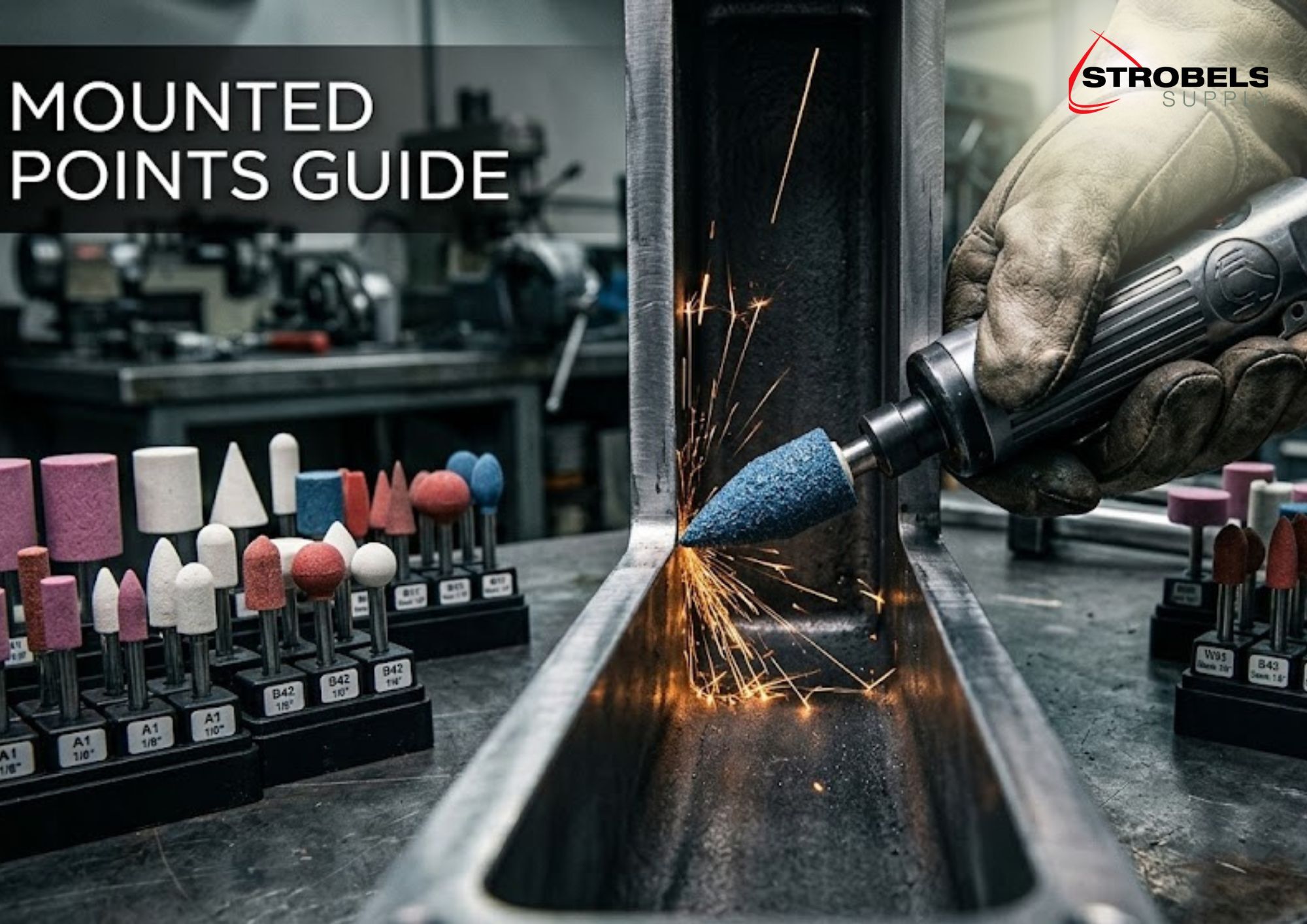
The Definitive Guide to Abrasive Mounted Points for Precision Grinding
Table of Contents
- Abrasive Mounted Points Overview
- Mounted Point Types by Material
- Shapes, Sizes, and Codes
- Brands, Kits, and Assortments
- Application Techniques, Safety, and Optimization
Abrasive Mounted Points Overview
Abrasive mounted points are miniature grinding wheels permanently bonded to a steel shank (mandrel), designed for high-precision material removal in tight or contoured spaces. Unlike larger grinding wheels or carbide burrs, mounted points deliver controlled, flexible action ideal for deburring, edge breaking, internal grinding, mold polishing, and toolroom detail work.
Construction
- Abrasive head: Vitrified, resin, unitized, or specialty bonded grain (aluminum oxide, silicon carbide, ceramic, etc.).
- Shank: High-strength steel, typically 1/8" (3 mm) or 1/4" (6 mm) diameter. Available in standard or extended lengths for deeper reach.
- Bond: Holds the abrasive grains; determines aggressiveness, heat resistance, and self-sharpening behavior.
Typical Uses Mounted points excel where access is limited: inside bores, slots, fillets, mold cavities, die details, and weld seams on complex parts. They are the go-to for tool & die makers, aerospace component finishing, medical device deburring, and high-mix job shops.
When to Use Mounted Points vs. Grinding Wheels, Burrs, or Stones
| Tool | Best For | Limitations vs. Mounted Points | Choose Mounted Points When... |
|---|---|---|---|
| Mounted Points | Precision contours, internal features, small radii | Slower on large flat areas | You need reach into holes, slots, or complex geometry |
| Grinding Wheels | High stock removal on open surfaces | Too large/rigid for internal or detailed work | Workpiece geometry is intricate |
| Carbide Burrs | Fast roughing on soft metals | Can leave rough finish or load on stainless | You need fine control and consistent finish |
| Mounted Stones | Ultra-fine polishing | Very slow material removal | You need aggressive yet controllable cutting |
Mounted points bridge the gap: faster than stones, more precise than burrs, and far more versatile than full-size wheels.
Common Applications
- Deburring machined edges and cross-holes
- Internal grinding of bores and ports
- Mold & die polishing and repair
- Toolroom sharpening and blending
- Weld cleanup in tight fabrications
- Composite and non-ferrous edge finishing
Mounted Point Types by Material
Conventional and Vitrified Mounted Points
Vitrified bond (most common) offers excellent form-holding and cool cutting on steel, cast iron, and stainless. Aluminum oxide for general-purpose; silicon carbide for non-ferrous, cast iron, and ceramics.
Specialty Materials
- Unitized / Non-woven: Standard Abrasives or Scotch-Brite style — for light deburring, blending, and finishing without loading. Ideal for stainless and aluminum.
- Cotton Fiber / Rubber: Flexible, produces satin finishes; excellent on soft metals and plastics.
- Resin-Bonded: Faster stock removal, cooler operation on heat-sensitive alloys.
- Ruby / Ceramic: Premium self-sharpening grains for hardened tool steels and superalloys.
- Diamond: For carbide, ceramics, glass, and hardened materials.
- Felt: Pure polishing with compounds (non-abrasive).
Material Selection Guide (Expert Recommendation)
| Workpiece Material | Recommended Material & Bond | Why It Works Best |
|---|---|---|
| Steel / Cast Iron | Vitrified Aluminum Oxide (A or W shapes) | Aggressive yet cool; excellent form retention |
| Stainless (INOX) | Resin INOX EDGE or Unitized | No loading, iron-free, prevents contamination |
| Titanium / Superalloys | Ceramic TOUGH or Resin | Heat-resistant, self-sharpening |
| Aluminum / Non-Ferrous | Silicon Carbide or Rubber | Non-loading, prevents smearing |
| Composites / Plastics | Unitized or Cotton Fiber | Gentle on fibers, no melting |
| Hardened Tool Steel | Ruby or Diamond | Extreme hardness and longevity |
Shapes, Sizes, and Codes
Standard Shapes and Codes (ANSI B74.2) Common families:
- A Shapes (cylindrical, pointed, cone)General-purpose deburring and blending (A1, A3, A11, A15).
- B Shapes (ball, bullet): Radius work and fillet blending.
- W Shapes (cylinder, cone): Straight grinding and edge work.
Shank Diameters and Dimensions
- 1/8" shank: For high-speed pencil die grinders and intricate work (up to ~50,000+ RPM possible).
- 1/4" shank: For heavier-duty straight grinders and higher torque applications.
- Common head sizes: 1/4" to 2" diameter; lengths from 1/2" to 3". Longer shanks increase reach but reduce max safe RPM.
Reading Mounted Point Charts and Catalog Specs Look for: Grit (coarse 36–60 for stock removal; fine 80–220 for finishing), Hardness/Grade (softer for fast cut, harder for form-holding), Bond type, and Max RPM (critical — always respect overhang limits per ANSI B7.1 / EN 12413).
Quick Shape Reference Table (Most Popular in Shops)
| Shape | Typical Use | Example Dimensions | Common Max RPM (1/2" overhang) |
|---|---|---|---|
| A1 | General deburring, edges | 3/4" x 2-1/2" | 19,800 |
| A3 | Long-reach internal grinding | 1" x 2-3/4" | 16,100 |
| A11 | Weld blending, slots | 7/8" x 2" | 19,860 |
| A25 | Flat surface prep | 1" x 1" | 34,500 |
| W222 | Precision blending | 1" x 1" (1/4" shank) | ~34,000 |
| B121 | Radius & fillet work | 1/2" x 1/2" | 45,370 |
Brands, Kits, and Assortments
Leading Brands
- PFERD: Premium TOUGH, INOX EDGE, and STEEL lines — exceptional on exotic alloys and stainless; best-in-class safety documentation.
- 3M / Standard Abrasives: Unitized and Scotch-Brite mounted points for burr-free finishing and composites.
- United Abrasives (SAIT): Excellent value vitrified and resin points; strong performer on cast iron and general fabrication.
Mounted Point Kits and Assortments
Shop kits (20–50 pieces) with mixed A, B, and W shapes in popular grits are ideal for toolrooms. They reduce downtime and let you test multiple options quickly. Look for kits with both 1/8" and 1/4" shanks.
How to Compare and Choose
Prioritize by application: PFERD or Norton for high-volume precision; United Abrasives or 3M for cost-effective daily use. Calculate TCO — a premium point that lasts 3x longer often beats cheap options when you factor in changeover time and scrap risk.
Application Techniques, Safety, and Optimization
RPM Limits & Tool Compatibility
- RPM: Never exceed the manufacturer’s rated speed for your overhang length. Use variable-speed die grinders.
- Pressure: Light to moderate — let the point do the work. Excessive force causes glazing or shank bending.
- Tool Compatibility: Collet must grip at least 50% of shank length. Use high-quality air or electric die grinders.
- Technique: Keep the point moving; use 10–15° angle for edge work; dress with a dressing stick when loading occurs.
Proper Grinding Techniques
- Always wear ANSI Z87.1 eye protection, gloves, and dust mask.
- Inspect for cracks or loose shanks before use.
- Store in dry conditions; never drop or strike points.
- Dispose of worn points responsibly — never reuse damaged shanks.
Common Problems & Fixes
| Problem | Likely Cause | Fix |
|---|---|---|
| Burning workpiece | Too hard bond or excessive speed | Switch to softer grade; reduce RPM |
| Glazing / Loading | Too fine grit or insufficient pressure | Use coarser grit; increase pressure slightly |
| Chatter / Vibration | Poor collet grip or imbalance | Re-clamp shank deeper; dress point |
| Poor finish | Wrong shape or grit | Match shape to geometry; step up in grit |
| Short life | Over-speed or heavy pressure | Respect RPM chart; use lighter touch |
Pro Shop Tip: For stainless and titanium, always dedicate points to one alloy family to prevent cross-contamination. In high-production toolrooms, color-code shanks by material type.
Looking for premium abrasive mounted points, unitized points, vitrified A-shapes, PFERD INOX/TOUGH lines, Standard Abrasives, United Abrasives resin points, and complete kits?
Strobel’s Supply stocks the full range from Norton, PFERD, 3M, United Abrasives, and more including every shape, shank size, and specialty material you need for precision work.
Browse the complete Mounted Points selection today: https://www.strobelssupply.com/products/abrasives/mounted-points/
Or explore the full abrasives section: https://www.strobelssupply.com/products/abrasives/
This guide is for educational purposes. Always follow manufacturer RPM ratings, ANSI B7.1 / EN 12413 safety standards, and your facility’s PPE requirements.